


Last Updated: November 8, 2026
Quick Summary
Heritage brands prioritize quality tobacco because reputation is the only asset that compounds over decades, and brand heritage enhances perceived quality and can support a price premium. At Padilla Cigar Company, twenty-one years of rolling cigars taught us that a brand name survives only as long as the leaf behind it.
- A heritage brand is built over decades of consistent production, not a single successful release.
- Tobacco quality is measured by priming position, leaf grade, moisture content, curing, fermentation, and blend consistency.
- Lot tracking follows each batch from harvest through box so defects trace to a specific field and process batch.
- Draw testing on finished cigars catches construction defects that visual inspection misses.
- Padilla was chosen among the Top 25 cigars of 2021 by Cigar Aficionado.
Table of Contents
- Heritage Brands and the Quality Tobacco Standard
- What Heritage Brand Means in the Cigar Industry
- Why Legacy Cigar Makers Treat Quality as Brand Identity
- What Makes a Cigar Premium: Leaf Selection and Tobacco Sourcing
- Handcrafted Cigar Construction: From Curing to Rolling
- Cigar Tobacco Aging: How Time Changes Flavor and Burn
- How Heritage Brands Verify Quality Across the Supply Chain
- Quality, Consistency, and Consumer Trust
- The Trade-Offs: Heritage Claims, Product Evidence, and Health Risk
- Choosing Your Next Padilla Cigar
- Frequently Asked Questions
Heritage Brands and the Quality Tobacco Standard
Walk into any serious cigar shop and ask why heritage brands prioritize quality tobacco, and you'll hear a version of the same answer: reputation is the only asset that compounds over decades. Research from the University of Georgia Terry College of Business explains why. Heritage branding that emphasizes a long history and consistency leads consumers to value continuity and authenticity, and it shapes how they judge product quality. At Padilla Cigar Company, that logic isn't abstract. Twenty-one years of rolling cigars taught us that a brand name survives only as long as the leaf behind it.
The distinction matters because "heritage" has become a marketing word. Plenty of labels print a founding date and call it tradition. Fewer can explain what they actually do differently in the field, the curing barn, or the rolling room.
Below, we break down what tobacco quality means in practice, how it's verified, and where heritage claims and product evidence part ways.
What Heritage Brand Means in the Cigar Industry
A heritage brand is a company whose identity, standards, and customer expectations were built over decades of consistent production, not a single successful release. In the cigar trade, that means continuity of blends, farming relationships, and rolling technique across generations of workers.
Two things separate a genuine legacy brand from a nostalgic one:
- Documented history. The company can trace its blends, factories, and key people across time.
- Carried-forward standards. Quality control decisions made decades ago still govern today's production.
A 2018 study led by F. Pecot, Cognitive Outcomes of Brand Heritage: A Signaling Perspective, found that brand heritage enhances perceived brand quality and can support a price premium for established companies. That's the commercial argument in one sentence. The study doesn't quantify the premium, and it shouldn't be read as a guarantee. Perception is a signal, not proof.
Why Legacy Cigar Makers Treat Quality as Brand Identity
For a legacy cigar maker, quality is part of the brand identity. When a name has been on the band for decades, a single bad batch can damage that reputation.
Consumer trust works the same way. A smoker who has bought the same profile for fifteen years isn't paying for packaging. They're paying for the expectation that the next box matches the last one. Break that expectation twice and brand loyalty doesn't recover.
What Makes a Cigar Premium: Leaf Selection and Tobacco Sourcing
A premium cigar starts with premium leaf, and premium leaf starts with where it grows. But "premium" is only useful as a claim if it can be defined. In practice, tobacco quality is a set of measurable properties, not a mood. Most serious operations evaluate leaf on the same core dimensions:
- Priming position. Leaves are harvested in stages up the stalk, from the volado at the bottom to the ligero at the top. Position determines thickness, nicotine content, combustion, and how the leaf behaves in a blend. A maker that can tell you the priming position of its filler is telling you something concrete.
- Leaf grade. Graders sort by size, color uniformity, elasticity, and defect load. A wrapper-grade leaf is a different product from a filler-grade leaf from the same plant, and the price difference is real.
- Moisture content. Leaf that is too dry crumbles and burns hot; leaf that is too wet invites mold and uneven combustion. Target moisture is a specification, checked with meters, not a matter of feel.
- Curing and fermentation. Curing controls how the leaf dries; fermentation controls ammonia, harshness, and the development of the compounds that produce flavor. Documented temperature and duration records are the difference between a process and a guess.
- Blend consistency. A blend is only as good as its repeatability. The test is whether the same proportions of the same grades from the same regions produce the same smoke batch after batch.
Tobacco sourcing separates serious makers from assemblers.
Watch out: a founding date and a farm name on the box are not evidence of any of this. Ask whether the brand can describe its grading criteria, its moisture targets, and how it holds a blend steady across years, those answers are the difference between sourcing as a practice and sourcing as a story.
Handcrafted Cigar Construction: From Curing to Rolling
Handcrafted cigar construction is the sequence of steps that turns raw leaf into a smokeable product, from curing and fermentation to hand-rolling.
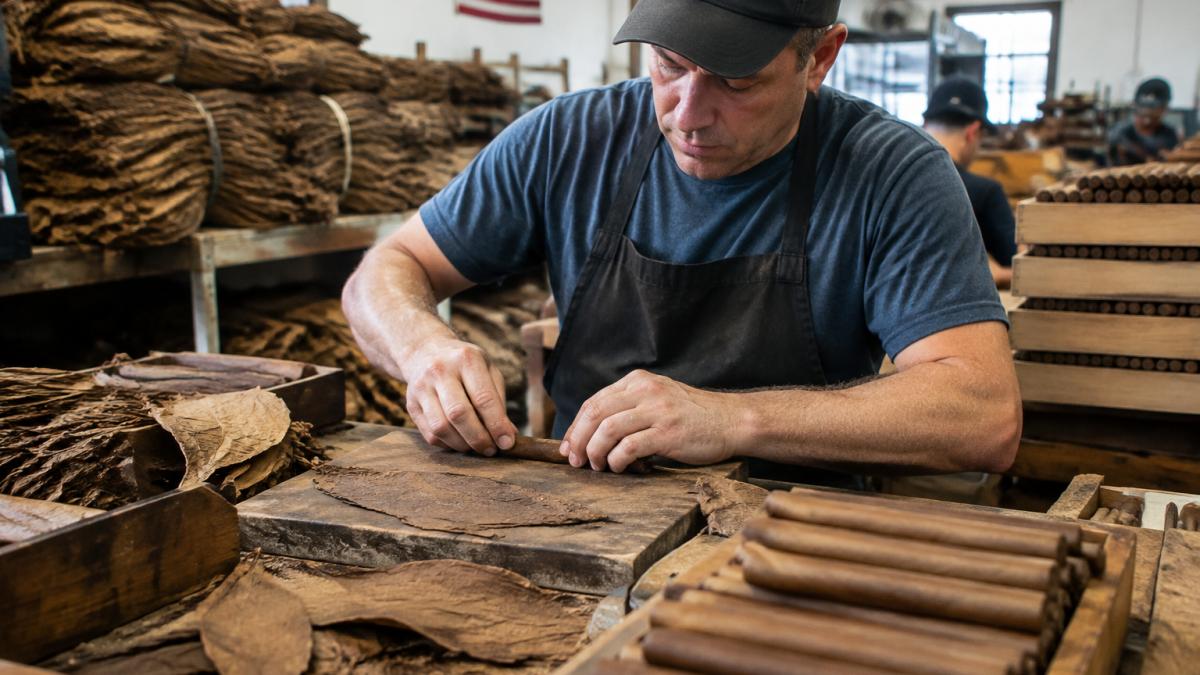
Hand rolling is a skilled craft, and handcrafted cigars are made by hand rather than by machine.
If you want the deeper technical picture, our guide on how to spot high-quality tobacco construction walks through the visual and tactile checks. For the broader case, read what makes handcrafted cigars better.
Cigar Tobacco Aging: How Time Changes Flavor and Burn
Cigar tobacco aging is the controlled rest that lets fermented leaf mellow, marry, and shed residual harshness before rolling and again after. Time changes flavor in measurable ways: sharp edges soften, oils stabilize, and combustion improves.
If you're still building your palate, our primer on cigar flavor profiles for beginners explains what aging actually does to what you taste.
How Heritage Brands Verify Quality Across the Supply Chain
Verification is where heritage claims earn or lose credibility. Customers can reasonably ask how any cigar brand checks quality before it reaches them.
- Lot tracking from harvest through box. Each lot carries an identifier that follows it through curing, fermentation, sorting, rolling, and storage, so a problem in a finished cigar can be traced to a specific field, harvest window, and process batch.
- Supplier oversight. Long-term grower relationships are backed by agreed grading criteria, delivery specifications, and rejection terms. A contract that accepts whatever arrives is not oversight.
- Process records. Documented fermentation temperatures and durations, curing conditions, and storage humidity are the evidence that a process was followed, not just described.
- Draw testing on finished cigars. Visual inspection catches appearance defects; draw testing catches construction defects that only show up when the cigar is smoked.
- Retention samples. Held samples let a maker compare a current batch against past batches and against the blend's reference standard.
- Failure enforcement. The real test is what happens when a batch misses spec. A producer that only inspects at the end is guessing. One that inspects at every stage can trace a defect to its cause and decide whether to rework, downgrade, or reject.
Watch out: traceability claims are easy to make and hard to check. A brand that can name its farms, describe its grading criteria, and explain what happens when a batch fails is offering evidence. A brand that offers only a founding date is offering nostalgia.
Quality, Consistency, and Consumer Trust
Consistency is the hardest promise in the cigar business and the one that builds consumer trust fastest. A blend that performs identically across boxes, years, and factories is evidence of manufacturing standards, not luck.
Consumer perception follows performance. Smokers forgive a lot, but not inconsistency in a product priced as a luxury good. That's the practical meaning of brand value in this category: the confidence that your money buys the same experience twice.
Awards help here, but only as corroboration. Padilla was chosen among the Top 25 cigars of 2021 by Cigar Aficionado and has been selected five times among the Top cigars in the world by the same publication. Those recognitions are useful because they're external. If you want to understand what actually qualifies a cigar for that kind of recognition, our breakdown of what makes a cigar award winning covers the criteria.
The Trade-Offs: Heritage Claims, Product Evidence, and Health Risk
Heritage is an asset and a constraint at the same time. A Yale School of Management analysis frames the tension directly: brand history can help or hurt when a company markets new innovations. Legacy makers that lean too hard on tradition can stall on product innovation, while those that abandon it risk losing the authenticity that justified their premium positioning.
Then there's the distinction too many brands blur: quality is not safety. The World Health Organization's guidance on tobacco and nicotine states plainly that tobacco damages nearly every organ and causes cancer, heart disease, stroke, and lung disease. No amount of craftsmanship changes that. A well-made cigar is a better-made tobacco product, not a safer one.
Watch out: no premium construction makes tobacco products safe, so judge heritage claims on the evidence rather than on health assurances.
Choosing Your Next Padilla Cigar
Choosing well comes down to matching the cigar to the occasion and trusting evidence over labels. Here's how we'd narrow it:
| Cigar | Price | Best For | Profile |
|---|---|---|---|
| Padilla El Titán: Rollers' Cut | $48.75 / 5-pack | Value seekers wanting long-filler quality | Rich, identical blend to premium lines |
| Five Authentic Corojo Robustos | $56.99 / 5-pack | Fans of classic Corojo character | Cedar, roasted nuts, leather, espresso |
| El Titan de Bronze Redemption | $170.00 / box of 10 | Collectors and special occasions | Earth, cedar, sweet leather, dried fruit |
| Padilla Artefacto Corojo | $35.95 / 5-pack | Everyday smoking | Nicaraguan Corojo, Jalapa and Condega fillers |
The Rollers' Cut deserves a note. These cigars were set aside during production for appearance standards, and only 150 cigars total are offered in 5-packs at $48.75 ($9.75 each).
Ready to choose? Browse the Special Selection to find your next smoke. Orders over $100 ship free within the U.S.
Heritage means nothing without the leaf to back it. Padilla Cigar Company has spent 21 years as a direct-from-factory producer, handcrafting award-winning cigars with the consistency that keeps collectors coming back. Start with the Rollers' Cut for value, the Corojo Robustos for classic character, or Redemption for the occasion that deserves it. Get started with Padilla Cigar Company and taste what two decades of quality-first production actually delivers.
Frequently Asked Questions
What is the highest quality tobacco for cigars?
There is no single highest quality tobacco, but the best cigar tobacco comes from carefully selected leaves grown in proven regions such as Nicaragua, Ecuador, and the Dominican Republic. Quality depends on seed variety, soil, priming position on the plant, curing method, and aging. Heritage makers judge leaves by aroma, elasticity, and appearance before blending. A 2018 study by Pecot and colleagues found that brand heritage enhances perceived brand quality, which is why established makers tie their name to specific farms and leaf grades.
Does cigar tobacco aging improve cigar quality?
Yes. Cigar tobacco aging mellows harshness and lets natural oils and sugars develop. Fermented leaves rest for months to years before rolling, and finished cigars often rest again so the blend settles. When you buy, ask how the cigars were stored and shipped, since dried-out stock undoes the benefit of aging.
Why do heritage cigar brands prioritize tobacco quality?
Because their reputation depends on repeatable results. A legacy brand's name is a promise that the next box tastes like the last, and that promise rests on consistent leaf selection, curing, and hand-rolling. Research from the University of Georgia Terry College of Business notes that heritage branding signals continuity and authenticity, which shapes consumer trust.
How can you tell whether a cigar is well made?
Check the wrapper for smoothness and small veins, feel for firm even packing without soft spots, and look at the cap for a clean, secure finish. A well-made cigar draws evenly and burns without canoeing. Ask about the blend's origin and the factory where it was rolled.
