


Last Updated: November 5, 2026
Quick Summary
Cigar flavor profiles describe the aromas and tastes you perceive while smoking, and they come from the tobacco leaf itself rather than anything added. Beginners should learn the six categories, earthy, spicy, woody, nutty, sweet, and floral, and treat them as a starting grid, not a rulebook, since most cigars blend two or three.
- Flavor is taste and aroma, body is smoke weight, and strength is nicotine delivery, so judge them separately.
- Maduro wrappers read sweet because a longer, hotter fermentation converts starches into sugars.
- Origin is the single biggest predictor of a cigar's flavor profile.
- Eat something bland and drink water about twenty minutes before smoking.
- Record three flavor words, body, strength, and what you ate or drank for each third.
Table of Contents
- Why Cigar Flavor Profiles Confuse Most Beginners
- Flavor, Body, Strength, and Aroma: What Each Term Actually Means
- The Main Cigar Flavors Chart: Six Categories to Know
- Sweet Cigar Flavors and Where They Come From
- Cigar Types and Names for Beginners, Decoded
- Cigar Flavor Profiles by Country of Origin
- How to Taste a Cigar: A Structured Exercise for Your First Few Smokes
- Building a Sampler That Teaches You Your Own Palate
- Frequently Asked Questions
Why Cigar Flavor Profiles Confuse Most Beginners
Cigar flavor profiles describe the aromas and tastes a smoker perceives while smoking, and they confuse beginners because the language used to describe them borrows from wine, coffee, and perfume all at once. Beginners often ask the same question: "What am I supposed to be tasting?" The honest answer is that flavor comes from the tobacco leaf itself, and a 2024 study of cigar tobacco flavor profiles confirms that flavor is shaped by tobacco source, type, and processing rather than by anything added.
Here is the part most guides get wrong: there is no universal flavor chart. Taste is subjective, and palate sensitivity, smoking technique, and pairing choices all shift what you perceive. Below, we walk through the terms, the six flavor categories, and a tasting exercise you can run on your first few cigars.
Flavor, Body, Strength, and Aroma: What Each Term Actually Means
Flavor is the combination of taste and aroma you register on the tongue and through the nose. Body is the weight and texture of the smoke on your palate, ranging from thin to thick and coating. Strength refers to nicotine delivery, not taste. Aroma is the scent of the smoke itself, both in the air and on the retrohale.
Beginners routinely confuse strength with flavor. A mild cigar can carry rich cedar and cream; a strong cigar can taste flat. Judge them separately or you will misread every cigar you smoke.
The Main Cigar Flavors Chart: Six Categories to Know
The six categories below cover most of what a beginner will detect. Use this as your working reference, not a rulebook. The right-hand column translates each term into a plain-language comparison so you have something concrete to match against what you smell and taste.
| Category | Common Tasting Notes | Plain-Language Reference | Where It Typically Shows Up |
|---|---|---|---|
| Earthy | Soil, mushroom, damp wood, beet | The smell of a garden after rain, or the inside of a fresh mushroom cap | San Andrés and broadleaf wrappers |
| Spicy | Black pepper, baking spice, chili, ginger | A crack of fresh black pepper, or the heat on the back of your tongue from cinnamon | Corojo and Habano seed |
| Woody | Cedar, oak, toasted wood, pencil shaving | The inside of a cedar chest, or a freshly sharpened pencil | Most aged tobacco, especially lanceros |
| Nutty | Almond, walnut, roasted nuts, peanut shell | The aroma of a nut roastery, or the skin of a roasted peanut | Connecticut shade and mild blends |
| Sweet | Cocoa, caramel, dried fruit, honey, molasses | Unsweetened cocoa powder, or the smell of a caramelizing pan | Maduro wrappers, aged fillers |
| Floral | Hay, grass, tea, orange blossom, dried herbs | A bale of dry hay, or a cup of mild green tea | Connecticut shade, mild Corojo |
Most cigars blend two or three of these. A single-category cigar is rare, and a cigar that reads as "just earthy" usually has sweetness underneath it. The reason is mechanical: the same leaf carries both earthy and sweet compounds, and fermentation and aging shift the balance between them. A longer, hotter fermentation converts starches into sugars, which is why maduro wrappers often read sweet even when the filler is earthy.
Watch out: do not chase exact notes. If a review says "cedar and baking spice" and you get "wood and something warm," you are not wrong, you are at the same place with less vocabulary. The categories are a starting grid, not a finish line.
Sweet Cigar Flavors and Where They Come From
Sweetness in a cigar is a natural product of the leaf, not an additive. Maduro wrappers get their dark color and cocoa-and-molasses character from a longer, hotter fermentation that converts starches into sugars. Aged fillers develop dried-fruit and caramel notes over time as oils and tannins settle.
Watch out: a sweet-tasting cigar is not a flavored cigar. If you want to understand how time changes a blend, our guide on how to age tobacco for better cigar flavor explains the process.
Cigar Types and Names for Beginners, Decoded
"Cigar types" usually refers to two things: the seed variety of the wrapper leaf, and the shape and size, called the vitola. Wrapper seed matters most for flavor. Connecticut shade gives cream and nuts. Corojo gives pepper and cedar. Maduro gives cocoa and earth.
Shape affects how the wrapper interacts with the filler. A lancero, at 7 x 38, puts more wrapper leaf against your palate per puff than a 6 x 52 toro, which is why slender cigars taste sharper and more focused. If you are still choosing your first premium cigar, our beginner's guide to choosing a first premium cigar walks through the decision step by step.
Cigar Flavor Profiles by Country of Origin
Origin is the single biggest predictor of a cigar's flavor profile. Nicaraguan tobacco tends toward pepper, cedar, and earth with a long finish. Dominican leaf is typically smoother and nuttier. Honduran tobacco lands between the two, with dry wood and light spice. Mexican San Andrés delivers dark cocoa and soil. Connecticut-grown leaf, used as shade wrapper, gives cream, hay, and mild sweetness.
To compare two origins side by side, the Padilla Maduro and Corojo Ten pairs a Mexican San Andrés Maduro against Nicaraguan-grown Corojo seed in one ten-cigar pack.

How to Taste a Cigar: A Structured Exercise for Your First Few Smokes
Most guides tell you to "taste in thirds" and leave it there. That is not a method; it is a slogan.
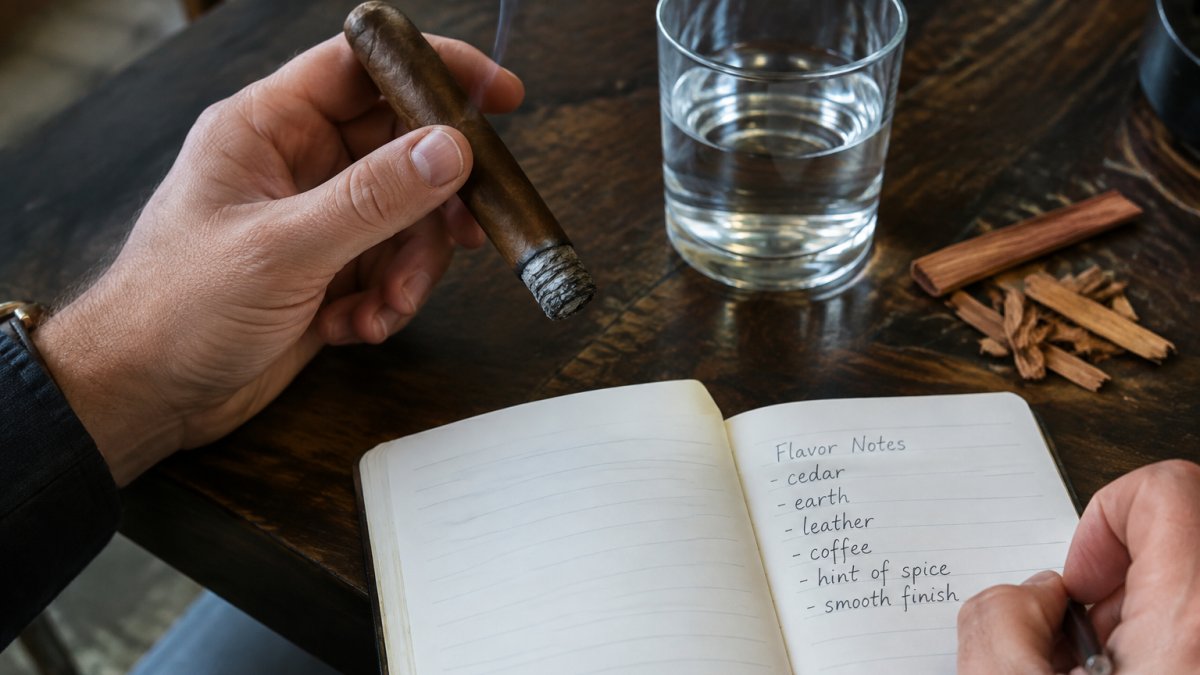
Before you light. Drink a glass of water and eat something bland, a cracker, a piece of bread, about twenty minutes before you smoke. A palate coated with spicy food, coffee, or garlic will read every cigar as bitter or flat.
The Padilla Maduro Masters 20 — Four Legendary Maduros, One Box →
Light evenly and draw slowly. A hot burn turns every cigar bitter and hides the sweetness. Two slow puffs, then rest the cigar for thirty seconds or so.
Run the thirds. Note the first impression before the ash reaches an inch. That is the first third. Repeat at the midpoint and again in the final third.
Use the retrohale, but gently. Push a small amount of smoke through the nose, no more than a quarter of what you drew, and note what you smell rather than what you taste.
Record four things, not one. For each third, write down (1) three flavor words, no overthinking; (2) the body, thin, medium, or coating; (3) the strength, judged separately from the flavor; and (4) what you ate or drank beforehand. The fourth item is the one beginners skip and the one that explains most of the variance between two smokes of the same cigar.
Run this exercise for your first five cigars:
- Draw slowly and retrohale a small amount of smoke through the nose
- Write down three words for the first third, no overthinking
- Note the body: thin, medium, or coating
- Note the strength separately from the flavor
- Record what you ate or drank beforehand
- Compare your notes to the same cigar a week later
Keep a journal, not a scorecard. A simple page per cigar works: date, cigar name and vitola, what you ate and drank, then three lines for the first, middle, and final third with flavor words, body, and strength. After five cigars, read back through the pages and look for patterns, you will usually find that you reach for the same two or three categories and that your tolerance for strength has moved. That pattern is your palate, and it is more useful than any published flavor chart.
A common mistake is smoking too fast. A hot burn turns every cigar bitter and hides the sweetness. Another is tasting on a full stomach of spicy food; your palate is already saturated. A third is expecting the exact notes a review promised.
Building a Sampler That Teaches You Your Own Palate
Build your sampler around contrast, not volume. Pick cigars that differ in wrapper color and origin so each smoke teaches you something. The Pursuit Of The Perfect Smoke 5 Pack Sampler gives you five distinct blends to compare, and the Padilla Grand Tour spreads ten blends across wrappers, shapes, and strengths for a broader education.


Smoke them in one sitting if you can, side by side, and write notes between each.
Frequently Asked Questions
How do beginners identify flavors in a cigar?
Start by slowing down. Take a slow draw, hold the smoke in your mouth for a second, and exhale through your nose to catch the aroma. Compare what you taste to familiar foods: cedar, black pepper, coffee, cocoa, leather, toasted nuts. Retronasal exhaling is where most of the flavor registers. Keep a small tasting journal and write down two or three impressions per third of the cigar. Over a handful of smokes, patterns emerge and your palate sharpens.
What is the difference between cigar flavor and cigar strength?
Flavor is what you taste and smell: cedar, pepper, cocoa, cream. Strength is the nicotine delivery and how much it hits your system. A cigar can be full-flavored but medium-strength, or mild in flavor yet strong in nicotine. Body sits between the two and describes the weight of the smoke on your palate. Judge flavor by taste, strength by how you feel, and body by how thick the smoke feels. They rarely move in lockstep.
Can a cigar flavors chart help beginners choose a cigar?
Yes, as a starting map rather than a rulebook. A cigar flavors chart groups tastes into families like earthy, spicy, woody, nutty, sweet, and floral, then points to blends that lean that way. Use it to pick two or three categories that appeal to you, then buy a sampler that spans them. Taste is subjective, so treat the chart as a compass. Your own notes matter more than any chart after the first few cigars.
How does the flavor of a cigar change as you smoke it?
Most cigars shift across three phases. The first third is usually lighter and cleaner, showing wrapper-forward notes like cedar, hay, or cream. The middle third builds body and brings filler flavors forward: earth, coffee, nuts, spice. The final third intensifies, often adding pepper, leather, and char. Some smokers call this the 1/3/5 rule, meaning flavors at the one-inch, three-inch, and five-inch marks differ noticeably. Smoke slowly and note each phase.
How do wrapper, filler, and country of origin affect cigar flavor?
The wrapper contributes roughly half the flavor impression because it touches your lips and burns first. The binder and filler build the base notes and determine body. Country of origin shapes the leaf's character: Nicaraguan tobacco tends toward pepper and earth, Dominican toward cedar and cream, Honduran toward bold earth and spice, and Mexican San Andrés toward dark cocoa and sweetness. A Padilla Maduro Masters 20 box lets you taste four Maduro blends side by side to see how these variables interact.
What are sweet cigar flavors and are they artificially flavored?
Sweet cigar flavors usually come from the tobacco itself, not additives. Maduro wrappers, cured longer with more natural sugars, deliver cocoa, dark chocolate, molasses, and dried fruit notes. Connecticut shade wrappers bring cream, vanilla, and graham cracker. A San Andrés Maduro over Nicaraguan filler, like the Padilla Miami Maduro, shows dark chocolate and roasted coffee with a touch of spice. Sweetness is a natural tobacco character, not a flavoring.
The hardest part of learning cigar flavor profiles is not tasting. It is trusting your own notes instead of a chart. Padilla Cigar Company has been handcrafting cigars for over 21 years, with award-winning blends recognized among the Top 25 cigars by Cigar Aficionado, and we ship free on U.S. orders over $100. Start with a sampler built for comparison, and let your palate do the rest. Get started with Padilla Cigar Company and find the blend you will come back for.
