


Last Updated: October 24, 2026
Quick Summary
Handcrafted cigars are rolled entirely by hand from whole tobacco leaves, while machine-made cigars are produced by automated equipment, often from chopped tobacco. That single distinction drives nearly every other difference in draw, burn, and flavor. A skilled roller adjusts each cigar by feel, adding or removing leaf until the draw is right.
- Long-filler tobacco burns slower, draws more evenly, and holds ash better than short-filler.
- Entubado bunching rolls each filler leaf into a tube for an open, even draw.
- A cold draw should feel like sipping through a coffee stirrer, with slight resistance.
- Keep cigars at 65 to 70 percent humidity to preserve oils and consistent draw.
- Match size, strength, price band, age, and storage when comparing handmade to machine-made.
Table of Contents
- Handmade Cigars vs Machine-Made Cigars: The Core Difference
- Long-Filler vs Short-Filler Tobacco: What Goes Inside
- Cigar Construction and Draw: Why the Roll Decides the Smoke
- How to Tell If a Cigar Is High Quality: A Buyer's Inspection Checklist
- Flavor, Aroma, and Complexity: What Good Leaf Delivers
- How Storage and Humidity Affect Performance
- Trade-Offs, Exceptions, and Whether Handcrafted Cigars Are Worth the Price
- Frequently Asked Questions
Handmade Cigars vs Machine-Made Cigars: The Core Difference
Handcrafted cigars are rolled entirely by hand from whole tobacco leaves, while machine-made cigars are produced by automated equipment, often from chopped tobacco. That single distinction drives nearly every other difference in draw, burn, and flavor. At Padilla Cigar Company, we have spent 21 years watching that gap play out in the hands of master rollers.
The difference is not marketing language. It is a production method with mechanical consequences, and you can taste them.
What Machine-Made Production Changes
Automated equipment compresses shredded tobacco into a uniform shape at high speed. Consistency is the goal, and the machines deliver it. The trade-off is that chopped filler packs unevenly against the wrapper, which frequently produces a tighter draw and a hotter burn. Machine-made cigars are also typically built from short-filler tobacco, a point we will return to shortly.
Speed and price favor the machine. Nuance does not.
Where Handmade Construction Earns Its Reputation
A skilled roller adjusts each cigar by feel, adding or removing leaf until the draw is right. You can see that skill in five authentic Corojo Robustos handcrafted by Cuban master rollers in Miami. Research on expert cigar ratings suggests combustion quality strongly influences whether experts recommend a cigar at all, which is exactly the variable hand-rolling controls most directly.

A common mistake is assuming "handmade" alone guarantees quality. It does not. A poorly rolled handmade cigar can smoke worse than a decent machine-made one. Construction skill is what matters, not the label.
Here is how the two production methods differ on the points that matter most.
| Aspect | Handcrafted | Machine-Made |
|---|---|---|
| How it is rolled | Rolled entirely by hand from whole leaves | Automated equipment, often chopped tobacco |
| Filler type | Long-filler tobacco | Typically short-filler tobacco |
| Draw and burn | Roller adjusts by feel for even draw | Tighter draw and hotter burn common |
| Strength | Nuance and construction control | Consistency and speed |
| Price | Costs more due to skilled labor | Wins on price and uniformity |
Long-Filler vs Short-Filler Tobacco: What Goes Inside
Long-filler tobacco consists of whole leaves running the length of the cigar; short-filler uses chopped leaf fragments. Long-filler burns slower, draws more evenly, and holds ash better.
The difference shows up in your hand before you ever light up. Roll a long-filler cigar gently between your fingers and you feel continuous leaf structure. A short-filler cigar feels lumpy or soft in spots.
Cigar Construction and Draw: Why the Roll Decides the Smoke
Construction determines how a cigar smokes more than any other factor. Wrapper, binder, and filler must be packed with even pressure from cap to foot, or the smoke channels unevenly.
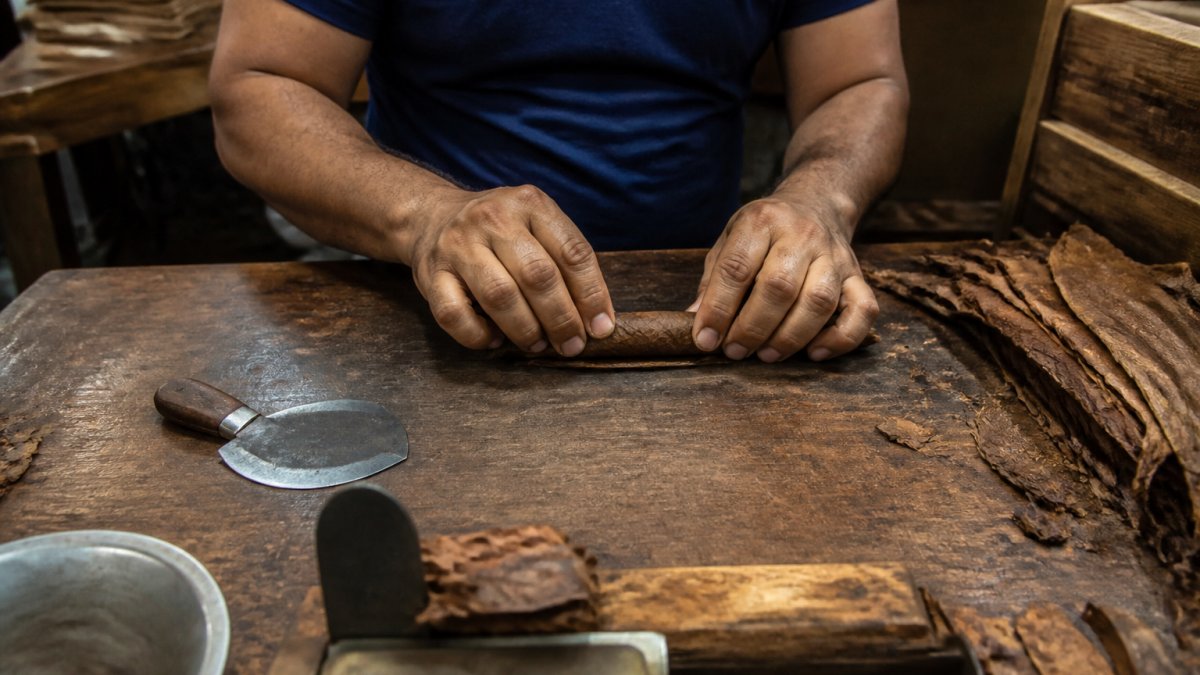
The Bunching Method Is the Hidden Variable
Two hand-rolled cigars of identical size and tobacco can smoke completely differently because of how the filler leaves were arranged. The two common methods are:
- Entubado: Each filler leaf is rolled into a narrow tube, and the tubes are gathered into a bunch. Air travels down the channels between tubes, which produces an open, even draw and a cooler burn. It is slower to execute and demands more skill.
- Accordion (book) folding: Leaves are folded back and forth like a fan and packed into the bunch. It is faster to roll but more prone to tight spots and uneven density if the roller is not careful.
Neither method is automatically superior, a sloppy entubado can still plug, and a well-executed accordion bunch can draw beautifully. But the method tells you what the roller was optimizing for, and it is one reason two cigars at the same price can perform very differently.
Draw Resistance and Airflow
Draw resistance is the effort required to pull smoke through the cigar. Slight resistance is ideal; it slows combustion and keeps smoke temperature down. Too tight and you fight the cigar, overheating it with every pull.
A useful diagnostic: a cold draw that feels like sipping through a coffee stirrer is roughly right. If it feels like pulling through a sealed straw, the bunch is plugged, often from over-packing near the cap or a stem left in the filler.
Burn Consistency and Smoke Temperature
An even burn depends on consistent filler density. When one side channels more air, the cigar burns crooked and the smoke turns sharp. Cooler smoke comes from a slow, even burn, which is where careful hand-rolling pays off most.
Three construction faults cause most burn problems:
- Soft spots in the bunch create a hot channel that races ahead of the rest of the burn line.
- Over-packing near the cap restricts draw and forces you to pull harder, which overheats the tobacco.
- A loose wrapper seam lets air in unevenly and produces canoeing that no amount of touch-up corrects.
A well-rolled cigar should hold a straight burn line through the first third without a single touch-up. If you are reaching for the lighter repeatedly in the first inch, the problem was set at the rolling table, not at the humidor.
The roller's skill is the whole story here, and it is why we point curious smokers to the Sandra Cobas Waited 30 Years to Roll This Cigar -MIAMI MADE, a classic 5⅝ x 46 corona extra, finished with a traditional Cuban pigtail cap.

How to Tell If a Cigar Is High Quality: A Buyer's Inspection Checklist
You can judge construction before lighting up. Use this checklist at the counter:
Five authentic Corojo Robustos. Handcrafted by Cuban master rollers in Miami →
- Wrapper is smooth and intact with no cracks, tears, or patchy discoloration
- Cigar feels firm and evenly packed from cap to foot, with no soft spots
- No visible veins or stems protruding from the wrapper
If three or more boxes fail, put the cigar down.
Flavor, Aroma, and Complexity: What Good Leaf Delivers
Flavor starts in the field. Leaf selection, priming position on the plant, and curing determine what a roller can work with.
Complexity is the ability of a cigar to shift in character as it burns.
Our Five authentic Corojo Robustos. Handcrafted by Cuban master rollers in Miami’s legendary boutique factory, show what that layered profile looks like in practice. This 5-pack is available for $56.99.
How Storage and Humidity Affect Performance
Even a flawless hand-rolled cigar smokes poorly if it has dried out or absorbed too much moisture. Humidity around 65 to 70 percent keeps tobacco oils intact and draw consistent.
Storage is the variable most smokers neglect, and it undoes more good construction than any other factor. For a practical walkthrough, see how to properly store premium cigars at home.
Trade-Offs, Exceptions, and Whether Handcrafted Cigars Are Worth the Price
Handcrafted cigars cost more because skilled labor costs more. That premium buys construction control, long-filler tobacco, and flavor complexity, but not automatically. A poorly stored handmade cigar is a waste of money, and a casual smoker may not notice the difference a premium roll delivers.
Here is the honest trade-off: machine-made cigars win on price and uniformity. Handcrafted cigars win on draw, burn, and character. If you smoke occasionally and want reliability, the machine is fine.
What the Premium Actually Buys
Strip away the marketing and the price gap between a handcrafted and a machine-made cigar of similar size comes down to a few concrete inputs:
- Labor time per cigar. A skilled roller produces a fraction of what a machine produces in the same hour, and that labor is the single largest cost line in a handmade cigar.
- Long-filler tobacco. Whole leaves cost more than chopped filler and require more careful handling to keep the structure intact.
- Quality control and rejection rates. Handmade cigars that fail draw or appearance checks are pulled before boxing; that loss is built into the price of the ones that ship.
None of that guarantees a better smoke. It explains why the price is higher, and why a cheap handmade cigar is a warning sign rather than a bargain.
A Fair, Like-for-Like Comparison Method
Most comparisons are unfair because they stack a premium handmade against a budget machine-made. To judge the categories honestly, control the variables:
- Match the size and shape. Compare a Robusto to a Robusto, not a Robusto to a Churchill. Ring gauge and length change draw and burn independently of construction method.
- Match the strength and tobacco origin. A mild Connecticut against a full-bodied Nicaraguan tells you nothing about rolling method.
- Match the price band. Compare cigars within a similar price range so you are testing construction, not budget.
- Control for age and storage. A fresh handmade against a well-aged machine-made is not a fair test. Rest both at the same humidity for the same period before smoking.
- Judge in the same session. Smoke them back to back, and score draw, ash structure, burn line, and how the flavor develops from first third to final third.
That test settles the question faster than any review. For a low-risk way to run it, our Padilla El Titán: Rollers’ Cut 5-pack lets you judge the difference yourself. These are available for $48.75.
The Exceptions Most Articles Skip
Handcrafted does not automatically mean better, and the exceptions matter:
- Skilled machine-made cigars can be remarkably consistent. Uniformity is the machine's strength, and for a smoker who wants the same experience every time, that reliability has real value.
- A badly rolled handmade cigar loses to a good machine-made one. Construction skill, not the label, is what you are paying for.
- Storage can erase the difference entirely. A flawless handmade that dried out in a hot warehouse will smoke worse than a well-kept machine-made cigar. Before you blame the roll, check the storage.
Choosing by Preference, Not by Label
Rather than asking whether handcrafted is better, ask what you want from the cigar:
- Want reliability and a low price per smoke? A well-made machine-made cigar is a rational choice.
- Want draw, burn, and flavor that develop as you smoke? Handcrafted is where that lives.
- New to cigars? Start mild, start smaller, and start with a sampler rather than a box.
Handcrafted cigars are worth the premium when construction and storage are both right. Paying more for a badly stored handmade cigar is worse value than a well-kept machine-made one. Compare like for like, control for storage, and buy to your palate rather than to the label.
Frequently Asked Questions
What is the difference between handmade and machine-made cigars?
Handmade cigars are rolled by skilled hands using long-filler tobacco leaves that run the full length of the cigar, which supports airflow and an even burn. Machine-made cigars typically use short-filler scraps and are produced by automated equipment, which can create a tighter or uneven draw.
How can I tell if a cigar is high quality before lighting it?
Run your fingers along the wrapper: it should feel smooth with no soft spots, hard lumps, or visible cracks. Check that the cap is neatly applied and the foot shows visible long-filler leaves rather than loose scraps. A well-made cigar feels firm but gives slightly when squeezed, and the draw should have mild resistance when you test it cold. These checks are the fastest way to judge construction before you commit to a box.
Why do handcrafted cigars burn differently?
Long-filler tobacco leaves are arranged lengthwise, so air moves through the cigar more evenly and the burn line stays straighter. Skilled rollers also control how tightly each section is packed, which affects draw resistance and smoke temperature. A looser roll can burn hot and fast, while an overpacked one can tunnel or go out. That is why construction and draw are the two factors most worth inspecting in any premium cigar.
Are handcrafted cigars worth the price?
The price reflects labor, leaf selection, and the small-batch nature of the work. A skilled roller produces far fewer cigars per day than a machine, and long-filler tobacco costs more than short-filler scraps. Whether that is worth it depends on how much you value an even burn, a controlled draw, and layered flavor. For occasional smokers, a five-pack is a low-risk way to compare handcrafted construction against what you normally smoke.
The gap between handcrafted and machine-made cigars comes down to judgment: a roller's hands adjusting each cigar versus a machine pressing them into shape. If you want to taste that difference for yourself, Padilla Cigar Company offers award-winning handcrafted cigars shipped direct from the factory, with free shipping on U.S. orders over $100. Browse our signature collections and limited releases, and buy now to find the blend that fits how you smoke.

See the difference handcrafting makes in the Padilla Miami 8&11, rolled by Cuban masters in Little Havana, or in our long-filler Casa de Padilla factory bundles.