


Last Updated: November 11, 2026
Quick Summary
Proper cigar storage for shipping means stabilizing cigars at roughly 65-70% relative humidity and 65-70°F for at least a week before packing, then holding that moisture steady in transit. Seal cigars in a rigid, airtight container with a two-way humidity pack sized to the container's volume, and add padded outer packaging to absorb shock.
- Hold your target humidity steady for at least a week before you pack.
- Match the humidity pack's rated volume to the container's interior volume.
- For three-to-five-day transit, use one pack rated for the next size up.
- Ship early in the week so the box doesn't sit in a warehouse over a weekend.
- Shake the finished box; if you hear movement, add padding.
Table of Contents
- Why Cigar Storage for Shipping Starts Before You Box
- Step 1: Condition Cigars at the Right Humidity Before Packing
- Step 2: How to Keep Cigars Fresh During Shipping
- Step 3: Choosing Cigar Humidity Packs for Shipping
- Step 4: How Long Cigars Can Go Without a Humidor in Transit
- Step 5: Shipping Cigars in Hot Weather Without Ruining Them
- Step 6: Packaging and Padding That Survive the Trip
- Step 7: What to Check the Moment the Box Arrives
- Frequently Asked Questions
Why Cigar Storage for Shipping Starts Before You Box
Proper cigar storage for shipping is the practice of stabilizing a cigar's moisture content before it leaves your humidor, then holding that moisture steady through transit. Get the first half wrong and no amount of padding saves the box.
Here's the tension most guides skip. A cigar is a living, breathing product. Its wrapper, binder, and filler are hygroscopic, meaning they constantly trade moisture with the air around them. Sealed in a box for three days, a dry cigar pulls moisture from wherever it can find it. A wet cigar pushes moisture out and swells.
So the question isn't "how do I pack cigars?" It's "how do I lock a cigar into its happy state and keep it there?"
Below, we walk through the seven rules we follow. Each one targets a specific failure point in transit.
Step 1: Condition Cigars at the Right Humidity Before Packing
The right humidity for shipping is the same range you'd store at: roughly 65-70% relative humidity at about 65-70°F. Ship a cigar outside that band and you're gambling with the wrapper.
Sources don't agree on one number. NewAir describes a "70/70 rule" of 70°F and 70% humidity, while Tabanero recommends 65-70°F and 65-70% humidity, and guidance summarized from Boveda's humidity guidance lands at 65-72% with 69% as a middle target. These are different recommendations, not one agreed standard.
Why the wait? Cigars absorb and release moisture slowly. A cigar that reads perfect on a hygrometer today may still be uneven inside. Give it time to equalize.
If you want the deeper reasoning on why consistency matters more than any single number, our guide on whether premium cigars really need consistent humidity breaks it down. For the practical home setup, see how to properly store premium cigars at home.
Step 2: How to Keep Cigars Fresh During Shipping
Keeping cigars fresh during shipping means controlling three things: moisture, temperature swings, and air movement. Miss any one and the cigar suffers.
The container is your first line of defense. A rigid, airtight box or travel case does two jobs. It buffers the cigar from outside humidity changes. It also stops the cigar from drying out against packing material.
Sealing the container without trapping stale air
Here's the mistake we see most. People seal a container so tightly that they trap humid, stale air against the tobacco for days. That air can carry mold spores and off-odors straight into the wrapper.
The fix is simple:
- Let the container air out for a few minutes before loading
- Add a humidity pack sized to the container's volume
- Leave a sliver of breathing room, not a vacuum seal
- Skip scented packing materials entirely
Cigars pick up surrounding smells fast. Cedar is fine. Bubble wrap that sat in a garage is not.
Step 3: Choosing Cigar Humidity Packs for Shipping
Cigar humidity packs for shipping are two-way moisture regulators. Unlike a damp sponge or a one-way humidifier, they absorb excess moisture and release it when air gets dry, holding a steady target. That two-way behavior is the whole point: a one-way humidifier can overshoot in a warm truck, while a two-way pack corrects itself.
Humidity packs are generally rated by the volume of the container they can regulate, not by the number of cigars. Match the pack's rated volume to the interior volume of your sealed container, then add a small reserve for multi-day transit.
Here is how to size the pack for the trip:
- Short domestic trips (one to two days): one pack rated for the container's interior volume
- Multi-day transit (three to five days): one pack rated for the next size up, so it has reserve to release moisture as the box cycles through temperature changes
- Long or international routes: two smaller packs placed at opposite ends beat one large pack, because moisture distributes more evenly across the cigars
Watch out: do not stack the pack directly against the wrapper. Wrap it loosely or set it at one end so moisture spreads evenly rather than soaking one spot. A pack pressed against a single cigar can over-humidify that spot and leave the rest of the box dry.
Verifying the pack before the box leaves
A common pattern is to seal the container with the pack and a hygrometer for 24 hours before adding cigars. If the reading holds inside your target band, the pack is doing its job. If it drifts, the container is leaking or the pack is spent. This step catches a failed seal or an exhausted pack while you can still swap it, rather than discovering the problem when the recipient opens a dry box.
For the deeper reasoning on why consistency matters more than any single number, see our guide on whether premium cigars really need consistent humidity.
Size the humidity pack to the trip, not to the number of cigars.
| Trip length | Pack sizing | Note |
|---|---|---|
| Short domestic trips (one to two days) | One pack rated for the container's interior volume | Match pack volume to container volume |
| Multi-day transit (three to five days) | One pack rated for the next size up | Reserve moisture for temperature cycles |
| Long or international routes | Two smaller packs at opposite ends | Moisture distributes more evenly |
| Before the box leaves | Pack plus hygrometer sealed 24 hours | Catches a failed seal or spent pack |
Step 4: How Long Cigars Can Go Without a Humidor in Transit
Cigars can tolerate a short period in a sealed, properly packed container without a humidor, but risk climbs the longer they stay outside one.
The variables that decide it:
- Wrapper thickness: a thick, oily wrapper holds moisture longer than a thin Connecticut shade leaf
- Ring gauge: larger cigars carry more mass and hold moisture better
- Container seal: an airtight case buys you days; a cardboard box buys you hours
- Outside temperature: heat accelerates moisture loss
Aging changes the math too. If you want to understand how time reshapes tobacco, our piece on how to age tobacco for better cigar flavor explains the chemistry.
Step 5: Shipping Cigars in Hot Weather Without Ruining Them
Shipping cigars in hot weather is the hardest scenario in this entire process. Heat does two things at once: it dries the tobacco and it can hatch tobacco beetles.
Keep the package out of direct sun and out of a hot truck bed. Ship early in the week so the box doesn't sit in a warehouse over a weekend. And tell the recipient to open the box promptly.
Cold weather and the freeze-thaw problem
USPS shipping restrictions on hazardous and perishable items are worth a read before you ship anything temperature-sensitive.
Step 6: Packaging and Padding That Survive the Trip
Padding protects against shock. It does not protect against moisture loss, so treat it as the second layer, not the first. The goal is a package that buffers both: a rigid inner container that holds humidity, and a padded outer layer that absorbs the drops and shifts of transit.
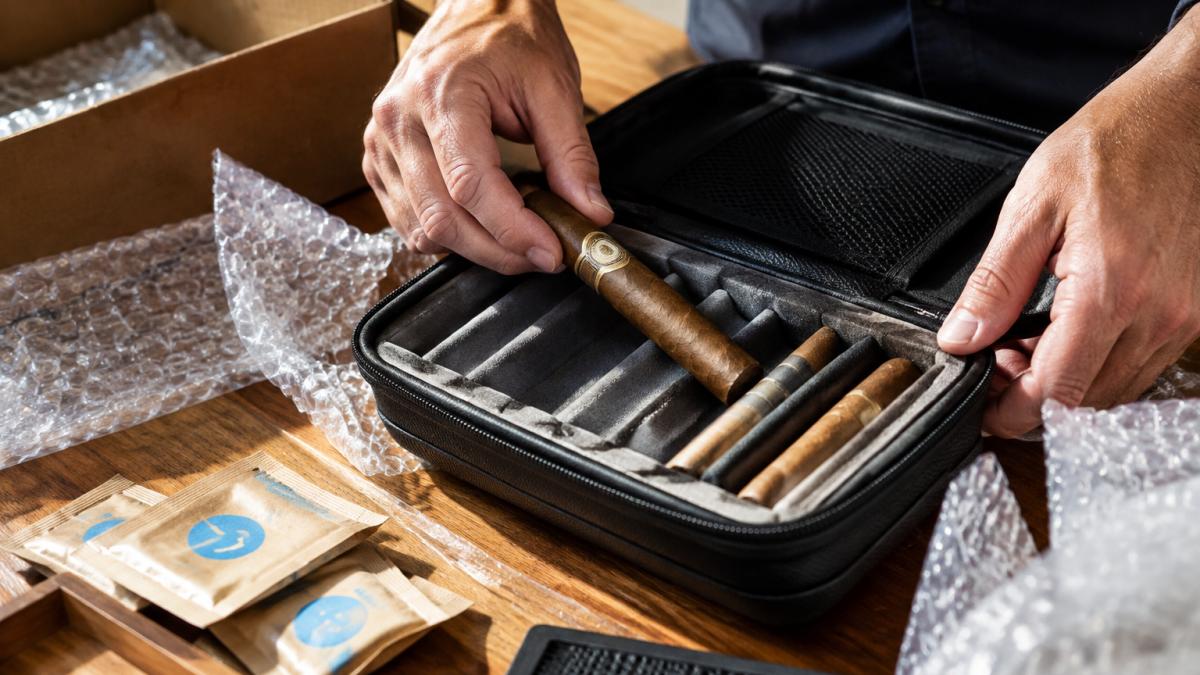
Build the package in this order:
- Cigar inside its humidity-controlled case
- Case wrapped in bubble wrap or foam
- Void space filled so nothing shifts
- Outer box rated for the weight
A cigar that rattles is a cigar that cracks. Shake the finished box. If you hear movement, add padding.
The failure modes padding is meant to prevent
Most transit damage to cigars shows up in three places: the foot, the cap, and the wrapper along the body. The foot is the most vulnerable because the exposed tobacco at the end has no wrapper to hold it together. A cigar that slides inside its case and slams into the end of the container can chip or split the foot before the recipient ever lights it. The fix is to fill the case so the cigar cannot slide, not just to wrap the case in bubble wrap.
The cap is the second weak point. A drop that lands on the head of the cigar can crack the cap even when the body looks fine. Foam or bubble wrap around the case absorbs that impact, but only if the case itself is rigid. A soft pouch protects against scratches, not against a fall.
Rigid versus padded: why you need both
A rigid case alone transmits shock straight to the cigars. A padded wrap alone lets the cigars flex and rub against each other. The combination, rigid inner case, padded outer layer, filled void space, is what survives a sorting facility. Cedar-lined travel cases add a nice aroma buffer, but cedar is also rigid, so the outer padding still matters.
Watch out: do not use packing materials that carry odor. Bubble wrap that sat in a garage, foam peanuts stored near solvents, or scented tissue can all transfer smell to the wrapper through the case's seams. Cedar is fine; anything with a chemical or perfumed smell is not.
Sealing the outer box without trapping moisture
Tape the outer box securely, but do not wrap the entire package in plastic film. Plastic film traps humid air against the container and can create condensation when the box moves between hot and cold environments. A taped cardboard box breathes slightly, which is what you want. The humidity control belongs inside the rigid case, not in the outer wrap.
For the inspection checklist to run the moment the box arrives, see the next section.
Step 7: What to Check the Moment the Box Arrives
Open the box immediately and inspect before you light anything. This is where you catch transit damage while you can still act.
Run this checklist:
- Wrapper intact, no cracks or splits at the foot
- Cigar feels firm but gives slightly to gentle pressure
- No visible mold, white fuzz, or blue-green spots
- No beetles or tiny holes in the wrapper
- Aroma is clean tobacco, not musty or sharp
- Cigar springs back when lightly squeezed
Then rest the cigars in your humidor for a few days before smoking. A shipped cigar needs time to re-equalize. Our cigar freshness inspection guide walks through each check in detail.
Shipping cigars well comes down to one habit: control moisture before the box closes, then protect it until the box opens. That's the standard we hold every order to at Padilla Cigar Company. Every cigar we ship is handcrafted in-house, backed by 21 years of experience and multiple Cigar Aficionado Top 25 selections. We also offer free shipping on U.S. orders over $100, so you can order with confidence. Get started with Padilla Cigar Company and taste what careful storage and shipping protect.
Frequently Asked Questions
How do you keep cigars fresh when shipping them?
Cigars are generally conditioned to a steady humidity before shipping, and a sealed container with a humidity pack holds internal conditions more steadily than loose packing, which is the core of cigar storage for shipping.
Do cigars need a humidity pack for shipping?
For anything beyond a day or two in transit, a humidity pack helps hold moisture steady. Match the pack size to the container volume.
How long can cigars stay fresh during shipping?
Cigars held in an airtight container with a humidity pack and moderate temperatures tolerate transit best over shorter periods, and risk rises with heat and handling, especially in summer.
How do you protect cigars from temperature changes during shipping?
In hot weather, insulation can help protect cigars from heat, and in cold months insulation can guard against freezing. Ask the recipient to unpack promptly once the box arrives.
