


Last Updated: October 26, 2026
Quick Summary
Premium cigars require consistent cigar humidity because tobacco leaf is a living material whose oils, wrapper, and filler stay in condition only when moisture balance stays steady. Too dry and oils evaporate, causing cracks and harsh smoke; too wet and the filler swells, plugging the draw and trapping ammonia.
- Standard storage calls for 65% to 70% relative humidity for balanced moisture, good draw, and full flavor.
- Season a new humidor three to four days with distilled water, then let it sit two to three more days.
- Check the hygrometer two or three times a week and log readings with date and room temperature.
- Rehumidify a dry cigar over one to two weeks in a stable 65% to 70% environment, never with a wet sponge.
- Keep the humidor between 65°F and 70°F, away from radiators, sunny windows, and air-conditioning vents.
Table of Contents
- Why Premium Cigars Require Consistent Humidity
- The Ideal Humidity for Cigar Storage
- Cigar Storage Temperature and Humidity Work Together
- How Humidity Changes Flavor, Aroma, and Burn
- How to Maintain Humidity in a Humidor
- How to Respond to Humidity Swings Without Overcorrecting
- How Long to Rehumidify a Dry Cigar
- Choosing Cigars That Reward Careful Storage
- Frequently Asked Questions
Why Premium Cigars Require Consistent Humidity
Premium cigars are a blend of aged tobacco leaves, and that leaf is a living, breathing material. Why premium cigars require consistent humidity comes down to moisture balance inside the roll. When that exchange stays steady, the tobacco oils, wrapper, and filler stay in condition; when it swings, the cigar you paid for stops tasting like the cigar we rolled. This guide explains what moisture does inside a cigar, the ideal cigar humidity for storage, and how to hold that range.
What Moisture Does Inside a Rolled Cigar
A rolled cigar holds three parts: the wrapper, the binder, and the filler. Each leaf carries natural tobacco oils that create flavor, and moisture keeps those oils in place. When a cigar dries out, those oils evaporate and the leaf turns brittle; the wrapper can crack and the smoke turns harsh. Too much moisture is just as bad: excess water swells the filler, blocks the draw, and traps ammonia compounds that need to escape.
The Ideal Humidity for Cigar Storage
Relative humidity is the amount of water vapor in the air compared with what the air can hold at that temperature (Discussion on Humidity).
| Storage Goal | Humidity Range | Why It Works |
|---|---|---|
| Everyday smoking | 62% to 65% | Cooler burn, drier wrapper, less relighting |
| Standard storage | 65% to 70% | Balanced moisture, good draw, full flavor |
| Long-term aging | 68% to 70% | Slower, steadier aging with less oil loss |
Cigar Storage Temperature and Humidity Work Together
Warm air holds more water vapor than cool air (Discussion on Humidity).
How Humidity Changes Flavor, Aroma, and Burn
Cigar humidity shapes flavor, aroma, and burn all at once. Moisture controls how the tobacco oils release, how the leaf combusts, and how fast the smoke travels. Get the range right and the cigar shows its blend. Miss it in either direction and the same cigar smokes like something else.
Too Dry: Fast Burn, Harsh Smoke, Lost Oils
An overly dry cigar burns fast and hot. The leaf has lost moisture, so combustion runs ahead of the smoker, pushing harsh, sharp notes to the front and hiding the sweeter tones in the blend. The wrapper can flake or split, and the draw feels loose and thin. Once tobacco oils evaporate, they do not come back.
Too Wet: Plugged Draw, Uneven Burn, Ammonia
An over-humidified cigar fights back. Excess moisture swells the filler and tightens the draw, so you pull hard for little smoke, and the burn turns uneven as one side lags behind. Wet tobacco also traps ammonia, and you taste it in the first third. If a cigar feels spongy and smokes bitter, excess moisture is the usual suspect.
How to Maintain Humidity in a Humidor
Maintaining humidity in a humidor is not a single setting. It is a repeatable loop: measure, compare, adjust in small steps, and wait. Most storage problems come from skipping the measurement step or adjusting too much at once.
Step 1: Season the Humidor Before It Holds Cigars
A new or long-empty humidor has dry Spanish cedar, and dry cedar pulls moisture out of the air and out of your cigars. Wipe the interior wood lightly with a clean sponge dampened with distilled water, not soaked, and close the lid. Repeat once a day for three to four days, then let the humidor sit empty with the humidifier charged for another two to three days. Add cigars only after the hygrometer holds a steady reading in your target range for a full day. Never season with tap water; the minerals stay in the wood.
Step 2: Charge the Humidifier Correctly
Overfilling is the most common mistake: a soaked humidifier spikes relative humidity, wets the cedar, and can swell cigars before the reading settles. Add water in small amounts and let the reading stabilize.
Step 3: Calibrate the Hygrometer With a Salt Test
If your unit reads 71%, it is 4 points low; note the offset and apply it to every reading, or adjust the unit if it has a calibration function. Repeat the test every six months, and after any drop or hard knock.
Step 4: Measure on a Schedule
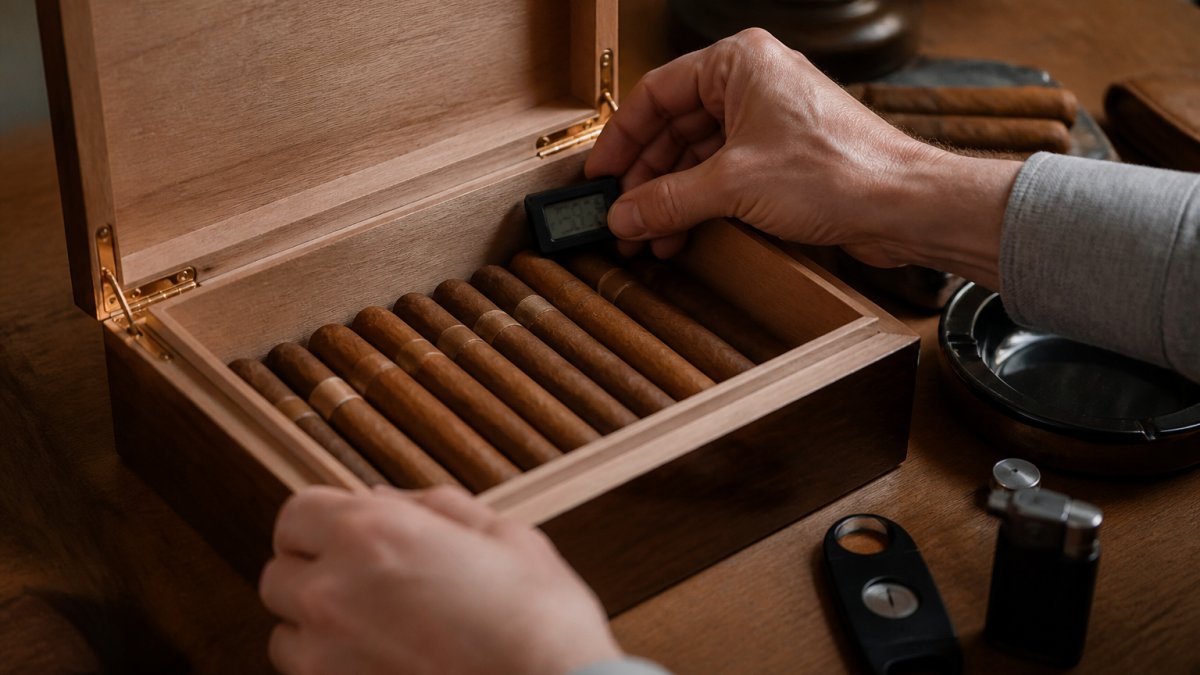
Check the hygrometer two or three times a week, and log the reading with the date and the room temperature. A written or app-based log turns a single number into a trend, and the trend tells you whether the humidor is stable or drifting. Keep the humidor between 65°F and 70°F, away from radiators, sunny windows, and air-conditioning vents.
Step 5: Adjust in Small Steps and Wait
When the reading drifts a few points, do nothing for a day; small changes often settle on their own. When a swing holds for two or three days, correct gradually: add a small amount of distilled water, or open the lid briefly to let moisture out. Never dump water in to chase a target. After any adjustment, wait at least 24 hours before measuring again.
Step 6: Rotate and Inspect
For a deeper walkthrough, see our guide on how to properly store premium cigars at home.
How to Respond to Humidity Swings Without Overcorrecting
Humidity swings are normal, and the worst response is a big correction. Season changes, weather fronts, and opening the lid all move the number. The useful skill is diagnosis: deciding whether a reading is a real problem, what caused it, and what safe action fixes it.
First, Rule Out Temperature
Temperature and humidity move together. Warm air holds more water vapor, so a humidor that warms up can show the same relative humidity reading while holding more actual moisture, and a humidor that cools can show a drop without losing water. Before adjusting humidity, check the room temperature and the humidor's location. Fix the temperature first, then recheck humidity after 24 hours.
Symptom, Likely Cause, Safe Action
| Symptom | Likely Cause | Safe Action |
|---|---|---|
| Hygrometer drops 3 to 5 points after a cold snap | Cooler air holds less moisture; reading falls with temperature | Warm the room or move the humidor; wait a day before adding water |
| Reading climbs after refilling | Overfilled humidifier or freshly seasoned cedar releasing moisture | Remove excess water, open the lid briefly, wait 24 hours |
| Cigars feel spongy, smoke bitter, need relighting | Excess moisture | Lower target toward 62% to 65%, dry the humidifier, inspect for mold |
| Wrapper cracks, burn runs hot and fast | Under-humidified or rapid rehydration | Move to stable 65% to 70%, rehydrate slowly over one to two weeks |
| One side burns faster, draw tight | Uneven moisture in the bunch, often from packing or rotation | Rotate cigars, check humidor airflow, rest the cigar before smoking |
| Draw tight but cigar feels dry | Construction issue (overpacked bunch) rather than moisture | Try a different cigar from the same box; if the pattern repeats, the issue is the roll, not the humidor |
| Tunneling or canoeing despite good readings | Uneven light, wind, or lighting technique | Rotate the cigar while smoking, light evenly, and check humidor rotation |
The Overcorrection Trap
When the reading drifts a few points, do nothing for a day. Small changes settle on their own. When a swing holds for two or three days, adjust in small steps: add a little distilled water, or open the lid briefly to let moisture out. Never dump water in to chase a target. Overcorrecting is how a stable humidor becomes an unstable one. After any adjustment, wait at least 24 hours before measuring again so the reading reflects the new equilibrium.
When the Problem Is the Cigar, Not the Humidor
Not every bad smoke is a humidity problem. A tight draw on a cigar that feels properly firm and slightly springy often points to an overpacked bunch or a plugged cap, not moisture. Tunneling and canoeing can come from uneven lighting or smoking in wind. Before you change your storage, smoke a second cigar from the same box. If the problem repeats across several cigars, check the humidor; if it follows one cigar, the issue is construction or lighting technique.
How Long to Rehumidify a Dry Cigar
Rehumidifying a dry cigar takes about one to two weeks in a properly maintained humidor, and longer for very dry cigars. Move the cigar into a stable 65% to 70% environment and leave it alone. Do not rush the process with a wet sponge or a sealed bag with water. Tobacco absorbs moisture slowly, and fast rehydration can crack the wrapper. Check after a week. A cigar that feels firm and slightly springy, not brittle, is ready. For cigars that were dry for months, give them three to four weeks and expect some flavor loss, since oils that evaporated will not return.
Choosing Cigars That Reward Careful Storage
If you want the full case for why these cigars earn the care, read what makes premium cigars worth it.
At Padilla Cigar Company, we offer award-winning, direct-from-the-factory handcrafted cigars, backed by over 21 years of experience. Get started with Padilla Cigar Company.
Frequently Asked Questions
What happens if my cigar is too humid?
An over-humidified cigar smokes wet. The filler swells and tightens the draw, the wrapper can split as it heats up, and combustion turns uneven, so you relight constantly. Smoke from tobacco stored above roughly 72% relative humidity often carries an ammonia edge because excess moisture traps compounds that would otherwise burn off. If a cigar feels spongy or cool and damp to the touch, move it to a lower humidity zone and let it settle for a week or two before lighting it.
What humidity is best for storing premium cigars?
Most collectors keep premium cigars between 65% and 70% relative humidity, with 69% to 70% acting as a common baseline for long-term aging. The right number depends on your conditions: during humid summer months, dropping to 62% to 65% can keep cigars balanced and prevent swelling, while drier climates may call for the higher end of the range. Pair whatever level you choose with a steady temperature near 70°F, since warm air holds more moisture and shifts the effective humidity inside the humidor.
Can a dried-out cigar be rehumidified?
Yes, but slowly. A cigar that has lost moisture needs weeks, not hours, to recover. Place it in a humidor held at 65% to 70% relative humidity and leave it alone for two to four weeks for a mildly dry stick, or up to two months for one that has been out for a long stretch. Rushing the process with a soaked sponge or a wet paper towel cracks the wrapper and leaves the filler uneven. Expect some loss of the tobacco oils that carry flavor, which is why consistent storage beats rescue every time.
How often should you check the humidity in a humidor?
Check a digital hygrometer every two to three days for the first month after setting up a humidor, then once a week once the readings hold steady. Analog hygrometers drift and should be calibrated with a salt test twice a year. Log the readings alongside room temperature so you can spot swings before they reach the cigars. If you open the lid daily to admire the collection, expect the humidity to dip each time, and give it a few hours to recover before adjusting anything.

Once your humidity is dialed in, fill the box with a 25-count Casa de Padilla Habano bundle or Maduro bundle from our factory bundles.