


Last Updated: October 23, 2026
Quick Summary
To properly store premium cigars at home, keep them at 65% to 72% relative humidity and 68°F to 70°F in a seasoned Spanish cedar humidor. Season a new humidor for about a week and calibrate the hygrometer before loading cigars. Arrange cigars loosely so air moves around them and check readings weekly once conditions hold steady.
- Season a new humidor for about a week before loading a full box of cigars.
- Run a salt test yearly: a calibrated hygrometer should read 75% after 6 to 8 hours.
- Keep cellophane on to protect wrappers from handling damage without preventing aging.
- Never store cigars in the refrigerator, where odors transfer and cold air dries wrappers.
- Keep temperature under 70°F as the best defense against tobacco beetles.
Table of Contents
- Why Proper Cigar Storage Matters
- The Ideal Humidity for Cigar Storage and Temperature Range
- How to Store Cigars in a Humidor: A Step-by-Step Setup
- How to Store Cigars Without a Humidor
- How Long Cigars Last in a Humidor
- Troubleshooting: Mold, Beetles, and Dry Cigars
- Organizing Cigars by Type to Avoid Flavor Transfer
- Conclusion
- Frequently Asked Questions
Why Proper Cigar Storage Matters
Learning how to properly store premium cigars at home starts with one fact: a fine cigar is a perishable product. Tobacco is a living leaf, and it reacts to the air around it. Store premium cigars badly and the wrapper cracks, the oils dry out, and the flavor turns harsh and thin.
At Padilla Cigar Company, we have spent 21 years crafting handcrafted cigars, and we know the leaf deserves better than a forgotten drawer.
Proper cigar storage protects three things:
- Flavor: natural oils carry the taste, and dry air pulls them out
- Freshness: stable moisture keeps the blend from turning flat
- Construction: a wrapper that stays supple will not split when you cut it
The good news? You do not need a walk-in vault. A simple, stable setup at home works well.
The Ideal Humidity for Cigar Storage and Temperature Range
The ideal relative humidity for cigar storage is 65% to 72%, with 68°F to 70°F as the target temperature. Most enthusiasts aim for about 69% to 70% humidity. That range keeps premium cigars supple without making them damp.
Temperature matters just as much as moisture. Warm air holds more water, so a hot room pushes the humidity up even when your device is set correctly. Keep your storage away from radiators, sunny windows, and kitchen heat.
You have probably heard of the 70/70 rule: 70°F and 70% humidity. It is a fine starting point, but it has limits. At 70°F, tobacco sits close to the range where tobacco beetles become active. Many collectors prefer to run slightly cooler and slightly drier, around 65% to 68% and 65°F to 68°F.
How to Store Cigars in a Humidor: A Step-by-Step Setup
Here is how to store cigars in a humidor so they stay in peak condition. Plan on about a week of setup before you load a full box. Most beginners rush this stage, and it is the single most common reason a new humidor swings wildly for its first month.
Step 1: Season and Calibrate a New Humidor
Seasoning is the process of adding moisture to the Spanish cedar lining so the wood stops absorbing it from your cigars. Dry cedar will pull moisture out of the leaf until the wood reaches equilibrium, which can take weeks if you skip seasoning.
- Wipe the interior cedar with a clean, lint-free cloth dampened with distilled water. Do not soak it. Excess water can warp the wood and invite mold.
- Place a small cup of distilled water inside and close the lid.
- Leave it for 24 hours, then check the hygrometer reading.
- Repeat for several days until the humidity holds steady near your target.
- Calibrate the hygrometer using a salt test or a calibration kit before you trust it.
How to run a salt test: Put a teaspoon of table salt in a small bottle cap, add a few drops of distilled water until it is a damp paste (not a puddle), and place the cap and your hygrometer together inside a sealed zip-lock bag. After 6 to 8 hours, a calibrated hygrometer should read 75%. If it reads 72%, you know it runs 3 points low and you can adjust your target accordingly. Repeat the test once a year, or any time the reading looks suspicious.
How to know the humidor is ready: The cedar should feel cool and slightly pliant to the touch, not damp. The hygrometer should hold your target for 24 hours with the lid closed and no humidification device added. If it drops overnight, the wood is still thirsty, keep seasoning. Only then should you add your humidifier and load cigars.
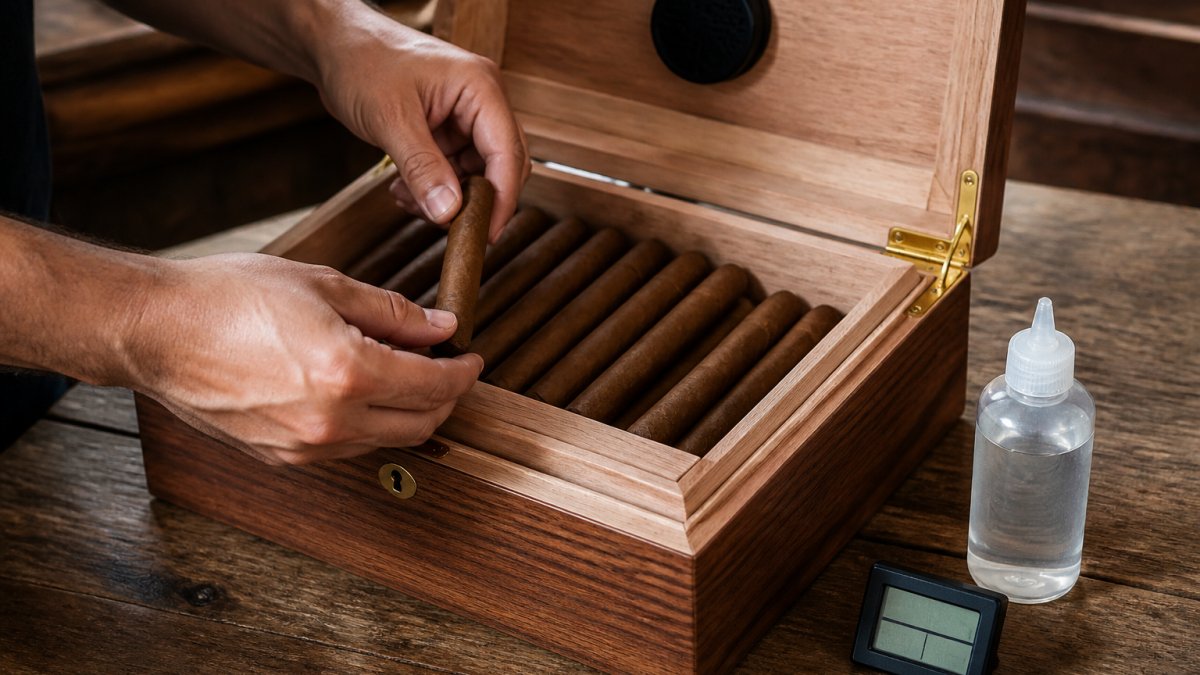
Skip this step and your new humidor will drink the moisture right out of your first batch.
Step 2: Load, Arrange, and Monitor Your Cigars
Arrange cigars loosely so air can move around them. Leave a little space between rows. Do not pack the humidor tight.
Check the hygrometer every few days at first. Once readings hold steady, a weekly look is enough. Rotate cigars occasionally so every one gets even exposure.
Step 3: Adjust for the Season
A humidor that holds 69% in spring can drift to 75% in a humid summer or crash to 60% in a dry winter. Check your readings against the outdoor season, not just the number on the dial. In dry months, add a second humidification device or move the humidor to an interior closet. In humid months, run slightly lower-target humidity packs and keep the lid closed as much as possible.
How to Store Cigars Without a Humidor
You can store cigars without a humidor for a short stretch using an airtight container. A plastic food container with a tight seal or a heavy zip-lock bag works as a temporary fix.
Follow these steps:
- Add a humidity pack rated for 69% to the container
- Place cigars inside, leaving room for air
- Keep the container out of sunlight and away from heat
- Open it briefly every few days to refresh the air
This setup holds cigars steady for days to a few weeks. It is not a long-term answer, because plastic offers no cedar and no insulation from temperature swings.
How Long Cigars Last in a Humidor
Cigars last for months in a properly maintained humidor, and many blends improve for years. How long cigars last in a humidor depends on steady conditions, not on the box itself.
| Storage Situation | Expected Freshness | Notes |
|---|---|---|
| Airtight container with humidity pack | Days to a few weeks | Temporary only |
| Humidor, well maintained | Months to years | Best for aging |
| Dry room or drawer | Days | Wrapper cracks quickly |
| Refrigerator | Not recommended | Odor transfer, drying |
For long-term storage, keep the humidity stable and check it often. Small, frequent adjustments beat one big correction.
Troubleshooting: Mold, Beetles, and Dry Cigars
Most storage problems show up as one of three issues. Here is how to spot each, what causes it, and what to do, plus how to keep it from coming back.
Mold appears as white, fuzzy patches. Light surface bloom (often called plume) wipes off easily and looks crystalline; fuzzy growth does not wipe away cleanly and may smell musty. If you find mold, isolate the affected cigars, lower the humidity by 3 to 5 points, and increase air circulation by opening the lid for a few minutes a day. Wipe the cedar with a dry cloth, do not scrub with water, which feeds the spores. Discard any cigar with mold on the foot, since the growth has entered the filler.
Tobacco beetles leave small, round holes in the wrapper and fine dust in the bottom of the humidor. The eggs are already in the leaf; warmth above roughly 75°F is what wakes them. Freeze affected cigars in a sealed bag for several days (a common practice is 3 days in a home freezer, then a slow thaw in the refrigerator for 24 hours before returning to the humidor), then move the humidor to a cooler spot. Keep your storage below 70°F and the risk drops sharply.
Dry cigars feel brittle and crack when squeezed. Bring them back slowly by raising humidity a few points at a time over several weeks. Rushing the process splits wrappers. A cigar that crumbles at the foot is usually past recovery, the oils are gone.
Prevention checklist:
- Keep temperature under 70°F, this is the single best defense against beetles
- Hold humidity in the 65% to 69% range rather than pushing 72%
- Open the lid briefly once a week to exchange air
- Never store cigars near a heat source, in a sunlit room, or against an exterior wall
- Inspect new arrivals before they go into the humidor, especially boxes bought in summer
Stable beats perfect. A humidor held at 66% all year will outperform one swinging between 60% and 75%.
Organizing Cigars by Type to Avoid Flavor Transfer
Tobacco absorbs nearby aromas, so organization protects your investment. Strong maduros and lightly flavored blends can trade notes over time.
Our simple approach at Padilla Cigar Company:
- Group cigars by strength: mild, medium, full
- Keep flavored or infused cigars in a separate container entirely
- Store aged cigars apart from new arrivals
- Label shelves or trays so you can rotate stock
For collectors, a small notebook or app that tracks arrival dates helps you age cigars with intention instead of guesswork.
Conclusion
Storing premium cigars well comes down to steady humidity, cool temperatures, and a little attention. Get those right and every cigar you pull from the humidor tastes the way the blender intended.
Padilla Cigar Company ships handcrafted cigars direct from the factory, with free shipping on U.S. orders over $100. Our award-winning blends have earned five selections among the Top cigars in the world by Cigar Aficionado, and each one deserves proper storage from day one. Browse our anniversary editions and signature collections, and give your cigars the home they deserve.
Frequently Asked Questions
Do you really need a humidor to store cigars?
A humidor is the most reliable way to store premium cigars long term because it holds a stable relative humidity and temperature. Without one, you can use an airtight container with a humidity pack for a few weeks, but the conditions drift faster and you have less control. If you plan to keep cigars for months or age them, a seasoned humidor with a calibrated hygrometer is worth the investment.
What temperature and humidity are best for storing cigars?
Aim for 68°F to 70°F and 69% to 72% relative humidity. The old 70/70 rule is a starting point, but many smokers run slightly drier to reduce mold risk in warm rooms. Keep the range stable rather than chasing an exact number, and check a calibrated hygrometer weekly. Avoid temperature swings above 75°F, which raise the risk of tobacco beetles hatching.
How can you tell if a cigar has dried out or become too moist?
A dry cigar feels brittle, cracks when squeezed, and burns hot and fast with a harsh taste. An over-humidified cigar feels spongy, may be difficult to draw, and can burn unevenly or go out. Gently press the cigar near the foot: it should give slightly and spring back. If it crumbles, raise humidity slowly; if it feels damp, drop humidity and dry it out gradually.
Should I unwrap my cigars before putting them in my humidor?
Leave the cellophane on if the cigar came wrapped. It slows moisture exchange slightly but protects the wrapper from handling damage and lets you organize sticks without flavor transfer. Cigars without cellophane age a bit faster and absorb ambient aroma more readily, so keep strongly flavored cigars separated. Either way, remove any outer cardboard or non-cedar packaging before storing.

Stocking up a humidor? A 25-count Casa de Padilla Maduro bundle or Habano bundle is a cost-effective way to fill it with cigars that reward proper storage.