


Last Updated: November 18, 2026
Quick Summary
Maintain cigar humidity while traveling by packing cigars in a sealed travel humidor with a tight gasket and a charged humidity pack sized to the case. Keep the case in your carry-on, out of hot cars and sun, and check a small hygrometer every couple of days to catch leaks or spent packs early.
- Hard cases with crushproof shells and foam slots are best for air travel; soft cases suit short car trips.
- Prep cigars about a day ahead and skip dry or crackly ones that will only worsen on the road.
- Keep the travel humidor in your carry-on, since checked baggage and cargo holds swing humidity sharply.
- Test a suspect seal by closing the empty case with a fresh pack and checking the hygrometer after a day.
- A high reading usually means too much pack capacity, so remove a pack and air the case out briefly.
Table of Contents
- Choosing a Travel Humidor That Holds Cigar Humidity
- Preparing Cigars Before Departure
- Cigar Humidity Packs: Capacity and Set Point
- How to Store Cigars Without a Humidor on the Road
- Packing Cigars for Flights and Long Trips
- How Long Cigars Last in a Travel Humidor
- Troubleshooting Humidity Fluctuations on the Go
- Building Your Padilla Travel Kit
- Frequently Asked Questions
Choosing a Travel Humidor That Holds Cigar Humidity
Maintaining proper cigar humidity while traveling starts with the case you pack. The right travel humidor holds a steady moisture level through flights, car rides, and hotel rooms.
A travel humidor is a sealed, padded container built to keep cigars at a stable moisture level away from home. It combines a hard or soft shell, foam or tray slots, and usually a small humidification source.
Hard Cases vs. Soft Cases
Hard cases win for air travel. A crushproof shell and foam slots protect the wrapper from pressure and knocks in a carry-on.
Soft cases suit short car trips and a jacket pocket.
What most guides miss is the seal. A case with a weak gasket leaks moisture no matter how many packs you add.
Here is how the two case types compare for holding cigar humidity on the road.
| Case type | Best for | Key difference |
|---|---|---|
| Hard case | Air travel | Crushproof shell and foam slots protect the wrapper |
| Soft case | Short car trips and a jacket pocket | Lighter and cheaper, but less crush protection |
| Soft case | Holding humidity | Holds humidity less evenly |
| Any case with a weak gasket | Holding humidity | Leaks moisture no matter how many packs you add |
Preparing Cigars Before Departure
Prep your cigars before you leave, not at the airport. If you are new to home storage, our guide on how to properly store premium cigars at home covers the basics.
Start about a day ahead:
- Pull the cigars you plan to smoke and let them rest at a stable home humidity.
- Skip cigars that feel dry or crackly; they will only get worse on the road.
- Charge or replace your humidity source so it starts full.
- Wipe down a new foam humidifier with distilled water, then let it settle.
A common mistake is packing cigars straight from a cold room into a hot car. The sudden swing shocks the wrapper and can cause cracking. Let the case come to room temperature first.
Cigar Humidity Packs: Capacity and Set Point
Set point is the target relative humidity the pack holds, and capacity is how much moisture it can move over time.
Match the number of packs to the case size and trip length.
If you want the deeper explanation of why steady humidity matters, read our article on whether premium cigars really need consistent humidity.
Watch out: over-humidification is as bad as dryness.
How to Store Cigars Without a Humidor on the Road
You can store cigars without a humidor on the road using a sealed container and a humidity pack.
Here is how we would do it:
- Pick a leak-proof, airtight container that fits your cigars snugly.
- Add one humidity pack sized to the space.
- Place cigars so they do not rattle or press on each other.
- Seal the lid and keep the container in a carry-on, not a hot trunk.
- Open it only when you plan to smoke.
A sealed bag inside a protective case gives you a second layer against dry air. Some smokers prefer a travel case without a pack for a short stretch, but that is a personal preference, not a general storage rule.
Packing Cigars for Flights and Long Trips
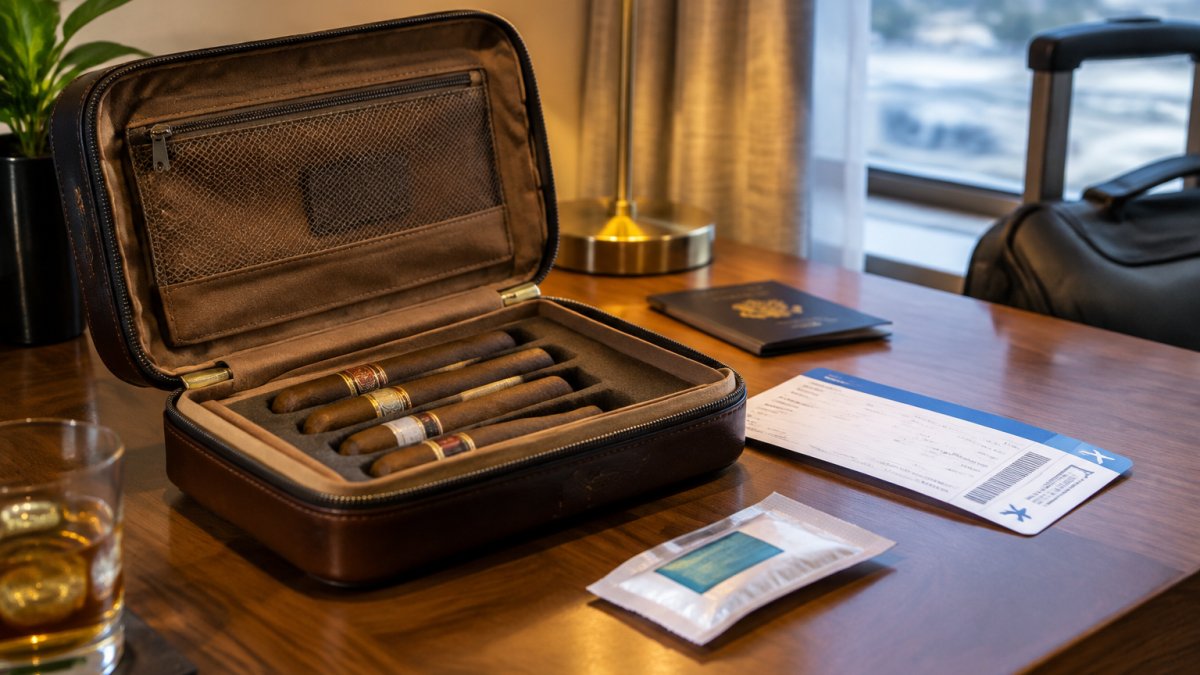
Packing for a flight comes down to three things: keeping the case in the cabin, getting it through screening without a hassle, and managing the climate shift at both ends. A hard case in a carry-on avoids the pressure and rough handling of checked baggage. Our guide on cigar storage rules for shipping without damage covers the packing habits that prevent cracks and dings in transit.
Carry-On vs. Checked Baggage
Keep the travel humidor in your carry-on. Checked baggage is the worst place for cigars: the cargo hold can get cold enough to drop relative humidity sharply, and bags sit on hot tarmac before and after the flight.
If you must check the case, seal it inside a heavy plastic bag first, pack it in the center of the bag surrounded by clothing, and accept that you will need to re-acclimate it on arrival.
Getting Through Security Screening
Cigars themselves are not restricted items, but the accessories around them can be. Pack a cutter in checked baggage.
A practical screening habit: keep the humidor in an outside pocket of your carry-on so you can pull it out and place it in a bin by itself.
Watch out: a torch lighter left in a carry-on can be confiscated at the checkpoint, and a cutter in a carry-on may be pulled for secondary screening even where it is ultimately allowed.
Managing the Climate Shift
A flight is a series of humidity shocks: dry cabin air, then a hot or cold arrival, then a hotel room with its own climate. Give the case a day to adjust before you open it wide.
On long trips, refresh the pack at the midpoint. If you change climates mid-trip, treat the first day as a settling period and check the hygrometer before you smoke from the case.
A Packing Sequence That Works
- Charge or replace the humidity source the day before you fly.
- Load cigars into the foam slots so they do not rattle or press on each other.
- Seal the case and place it in an outside pocket of your carry-on.
- Pack the cutter in checked baggage and confirm the lighter rules for your airline and route.
- On arrival, let the case come to room temperature before opening it fully.
This sequence keeps the case accessible at screening, protects the wrapper from pressure, and gives the humidity source a full charge before the dry cabin air starts working on it.
How Long Cigars Last in a Travel Humidor
The exact time depends on the seal, the pack capacity, and the outside temperature.
A few things shorten that window:
- A weak seal that leaks moisture
- Heat exposure in a car or sunny bag
- A pack that started partly dry
- Opening the case often in dry air
A hygrometer takes the guesswork out of it. Check the reading every couple of days on a long trip. If it drops, add or refresh a pack rather than waiting.
Troubleshooting Humidity Fluctuations on the Go
Humidity swings on the road usually trace back to heat, a bad seal, or a spent pack. The useful skill is reading the evidence: what the hygrometer says, how fast it changed, and what the cigars feel like. When humidity goes wrong, you also need to judge whether your cigars are still fresh, and our guide to telling if cigars are fresh walks through the inspection.
Reading a Hygrometer on the Road
A small digital hygrometer takes the guesswork out of a travel case. Check it every couple of days on a long trip, and always after a flight or a long drive.
If the reading looks wrong, cross-check by feel: a properly kept cigar is firm but gives slightly when pressed, with a wrapper that looks smooth rather than brittle.
Diagnosing a Leaking Case
A case with a weak gasket leaks moisture no matter how many packs you add. To test the seal, close the empty case with a fresh pack inside and check the hygrometer after a day. If the reading falls well below the pack's set point, the seal is the problem, not the pack.
Common seal failures:
- A gasket with grit or dried residue on it
- A lid that does not seat evenly because the case is overfilled
- A soft case whose zipper or flap has stretched
Wipe the gasket clean, make sure the lid closes without force, and move to a hard case if the seal keeps failing.
Diagnosing a Spent Pack
A two-way pack holds its set point until its capacity is used up, then stops correcting. If the hygrometer drops and the pack feels dry or stiff, replace it rather than adding water. Refreshing packs midway through a long trip is cheaper than losing a wrapper to dryness.
Responding to Readings That Are Too Low
A low reading means moisture is leaving faster than the pack can replace it. Check the seal first, then add or refresh a pack. If the case was left in a hot car or a sunny bag, move it to a cooler spot before adding moisture; heat drives the loss, and a new pack will just fight the same condition.
Responding to Readings That Are Too High
A high reading usually means too much pack capacity for the case volume. Remove a pack and let the case air out briefly with the lid open in a stable room.
Watch out: opening a case in a damp room to "air it out" can add moisture rather than remove it, so air it out in a dry, stable space.
Recognizing Damage and Recovering Cigars
Wrapper cracking after travel usually means the case got hot or dried out; move it to a cooler spot and give it time at a stable level before smoking.
Heat is the quiet culprit. A case left in a hot car can swing humidity and damage the wrapper in hours. Keep it in the cabin or a shaded bag, and check the hygrometer before you trust the case with premium cigars.
Building Your Padilla Travel Kit
A good travel kit is small, sealed, and ready to go. If you are assembling a kit for a trip, you can browse affordable 5-packs suited to travel.
Padilla Cigar Company has crafted award-winning, handcrafted cigars for over 21 years, and was chosen among the Top 25 cigars of 2021 by Cigar Aficionado.
A simple kit checklist:
- Hard travel case with a tight seal
- Two humidity packs at your target level
- Small hygrometer
- Cutter packed in checked baggage
- Sealed backup bag
The challenge is simple: a dry cabin or a hot car can undo months of careful storage in a single afternoon.
Frequently Asked Questions
Should you put a humidity pack in a travel case?
Yes, for most trips. A humidity pack keeps cigar humidity stable inside the sealed case, especially on trips longer than a few days or in dry climates. Choose a pack sized for the case's internal volume and a two-way set point near 69% relative humidity. For a short overnight trip, a well-seasoned case and properly stored cigars can hold fine without one, though adding a pack costs little and removes the guesswork.
How long can cigars stay fresh in a travel humidor?
Beyond that, check the pack and hygrometer regularly. In hot or very dry conditions, expect a shorter window and plan to recharge or replace the pack. Cigars stored slightly over-humidified before packing tend to hold up better than dry ones.
What humidity level should cigars be kept at while traveling?
Aim for roughly 65% to 69% relative humidity during travel. The classic 70/70 rule (70% humidity at 70°F) is a starting point, but many smokers prefer slightly lower humidity for travel because it reduces over-humidification risk and keeps wrappers from swelling. Avoid letting the case climb above 72%, and never let it drop below 60% for more than a day or two.
Can cigars dry out or become too humid in a travel case?
Both can happen. A loose lid, a spent humidity pack, or a dry climate can pull moisture out of the wrapper and leave cigars brittle. A fresh pack in a hot car or a case left in direct sun can push humidity too high, causing tight draws and wrapper cracks. Check the hygrometer daily, keep the case out of heat, and swap packs before they fully dry out.
