


Last Updated: November 2, 2026
Quick Summary
You spot fake premium cigars online by checking the seller before the product: confirm a physical address, a working phone, and card payment, then inspect seals, box codes, band print quality, and wrapper construction on delivery. Counterfeiters copy Nicaraguan, Guatemalan, and Dominican brands too, and taste alone will not expose a fake built from genuine leaf.
- Counterfeiters now copy Nicaraguan, Guatemalan, and Dominican cigars, not only Cuban brands.
- A seller with no address or a contact form as the only channel is a pattern worth walking away from.
- Rare, aged cigars listed as permanently in stock is a catalog red flag.
- Photograph the shipping box, seals, box code, and bands before smoking a suspect delivery.
- Padilla Cigar Company has spent 21 years crafting handcrafted cigars direct from the factory.
Table of Contents
- Why Counterfeit Cigars Slip Past Online Buyers
- Signs of Counterfeit Cigar Packaging
- How to Inspect Cigar Bands and Wrapper Construction
- How to Verify Authentic Cigar Retailers Before Ordering
- Best Practices for Buying Cigars Online
- What to Do When a Delivered Cigar Looks Counterfeit
- Order Direct From Padilla Cigar Company
- Frequently Asked Questions
Why Counterfeit Cigars Slip Past Online Buyers
Counterfeit cigars slip past online buyers because a fake can be built from real tobacco and wrapped in packaging that looks convincing on a screen. At Padilla Cigar Company, we have watched this problem grow as buying shifts online. Counterfeiters no longer target only Cuban brands.
Here is the part most guides get wrong. Taste alone will not save you. Some fakes use genuine leaf, so the draw and flavor can feel right, as Cigars Daily's construction analysis has shown. That is why fake premium cigars are caught with your eyes, not your palate.
So how do you spot fake premium cigars online? You check the packaging, the band, the seller, and the delivery. Below, we walk through seven checks that work before you pay and after the box lands.
Signs of Counterfeit Cigar Packaging
Counterfeit packaging usually fails in small, repeatable ways. Look at the seal, the codes, and the print quality. Each one is hard to fake well.
Warranty Seals, Holograms, and Seal Placement
A genuine warranty seal should sit flat, stick firmly, and show a clean hologram. Fakes often peel at the edges or look dull. Habanos S.A. seals carry a holographic strip with a unique barcode you can check through the official verification portal, per Cuban Cigar Online's seal guide. Check seal placement too. A seal that is crooked, re-glued, or stuck over a tear is a red flag.
Box Codes, Date Codes, and Printing Quality
Real box codes and date codes are stamped clean and readable. Counterfeit boxes often show smudged ink, misaligned borders, or missing embossing. A review of 16 studies by the Premium Cigar Association found that authenticity checks belong at the point of sale, because buyers cannot always tell later.
Watch for these packaging red flags:
- Blurry or bleeding ink on the band
- Print that sits off-center
- A hologram that does not shift in the light
- White boxes with thin, patchy borders
- A price that is too good to be true for a rare cigar
How to Inspect Cigar Bands and Wrapper Construction
Real cigar bands use sharp printing, clean edges, and crisp embossing. Fakes show ink bleeding, off-register printing, and missing fine detail, according to Cigar & Cocktail Magazine's band standards.
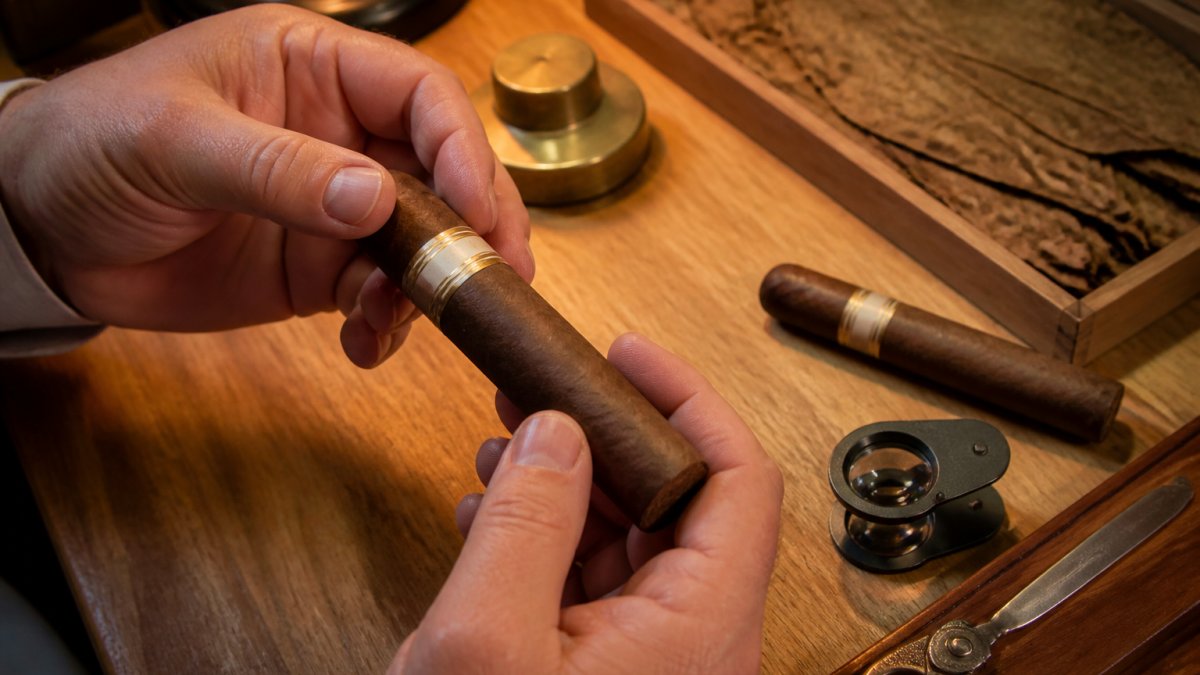
Next, study the wrapper. An authentic cigar has a smooth wrapper with small, even veins and uniform color. For a deeper guide to judging high-quality tobacco construction, see our full article. A fake often looks bumpy, with large veins and patchy color, per Cigar La Gloria's inspection guidelines. Give the body a gentle squeeze. It should feel firm, not loose or soft. Run your thumb along the surface and look for rips, tears, or a ragged cap.
How to Verify Authentic Cigar Retailers Before Ordering
Most guides tell you to inspect the cigar. Almost none tell you how to inspect the seller, and that is where most counterfeit losses actually start. A verification workflow for the seller works the same whether the cigars are Nicaraguan, Dominican, Honduran, or anything else, which is why it belongs before any packaging check.
Confirm the seller is a real, traceable business
Start with identity, not product. A legitimate retailer publishes a physical business address, a working phone number, and an email domain that matches the storefront. Call the number during business hours and see whether a person answers. A storefront with no address, a contact form as the only channel, or a domain registered a few months ago is a pattern worth walking away from.
Audit the catalog and the photos
Counterfeit sellers often list rare, aged, or limited-production cigars as permanently in stock. Genuine retailers sell out. Check whether the product photos are original: reverse-image search a few band and box shots, and look for the same photo reused across unrelated sites. Read the product copy for generic filler, mismatched vitola names, or sizes the manufacturer does not actually make. Cross-check the listed sizes and packaging against the manufacturer's own published catalog.
Test the payment and shipping terms
Payment method is your strongest pre-purchase lever. A seller who steers you away from card payment on a large order is telling you something. Ask in writing how the cigars are stored and shipped, whether humidity control is used in transit, and what the return window is. Get the answers in an email so you have a record.
Read reviews like an investigator
Look for reviews tied to named buyers with order details, not anonymous five-star bursts posted in the same week. Check third-party review platforms and cigar forums for the seller's name. A common pattern is a cluster of glowing reviews on the seller's own site and a separate trail of complaints elsewhere.
Watch out: a polished storefront, professional photography, and a plausible About page cost a counterfeiter very little, so treat presentation as neutral evidence and weigh traceability and payment protection far more heavily.
If a seller offers rare, expensive cigars far below normal, treat it as a warning. Rarity plus a low price is the oldest trap online. For a deeper look at buying safely, see our guide on how to buy premium handcrafted cigars online.
Before you inspect a single band, run the seller through these checks.
| Check | What to look for | Red flag |
|---|---|---|
| Business identity | Physical address, working phone, matching email domain | No address or contact form only |
| Phone test | A person answers during business hours | Nobody answers |
| Domain age | Established domain | Domain registered a few months ago |
| Catalog | Rare cigars sell out | Rare, aged cigars permanently in stock |
| Product photos | Original shots | Same photo reused across unrelated sites |
| Listed sizes | Match manufacturer's published catalog | Sizes the manufacturer does not make |
| Payment | Card payment accepted | Seller steers you away from card payment |
| Reviews | Named buyers with order details | Anonymous five-star bursts in the same week |
Best Practices for Buying Cigars Online
Smart buying habits cut your counterfeit risk fast. Use these rules every time:
- Buy from sellers with a clear return policy.
- Ask how the cigars are stored before shipping.
- Pay with a method that offers buyer protection.
- Keep your order confirmation and photos.
- Check the box and seals the moment it arrives.
Price is not proof of quality, but a suspiciously low price on a rare cigar is a real signal. Pair that with poor print quality and visible rips or tears, and you have the main markers that names as top counterfeit signs.
What to Do When a Delivered Cigar Looks Counterfeit
Stop and document before you smoke. This is the step buyers skip, and it is the one that decides whether a dispute succeeds. Treat the delivery like evidence: photograph the shipping box and label, the outer box, every seal and its edges, the box code and date stamp, each band, and any damage. Shoot in daylight, keep the images in focus, and include a scale reference. Do not open sealed boxes further than needed to inspect them, and do not smoke, cut, or discard anything until the issue is resolved.
Contact the seller in writing first
Send one clear email that states the order number, what you received, which specific checks failed, and what you want: a refund, a replacement, or a return authorization. Attach your photos. Keep the tone factual and keep every reply. Most payment disputes require that you show you tried to resolve the issue with the merchant first, so this message is part of the record, not just courtesy.
Preserve your payment protections
If you paid by credit card, contact your card issuer promptly to ask about its dispute process. Contact the card issuer in writing and describe the problem as goods not as described. If you used a payment processor with buyer protection, open the case inside that platform's stated window. Do not ship anything back until the seller or the dispute process tells you to, and if you do return it, use a trackable method and keep the receipt.
Report the seller where it counts
You can also file a complaint with consumer protection authorities. If the product claims a specific brand's authenticity and appears counterfeited, you can also notify the brand's customer service with your photos and order details.
Assess condition, not just authenticity
A cigar can be genuine and still arrive unusable. Check for cracked wrappers, split feet, mold, tobacco beetles, and a dry or spongy feel that signals poor storage in transit. Store what you keep properly while you sort it out. Our guide on how to properly store premium cigars at home covers the details. Knowing what makes a premium cigar worth the price helps you judge whether what arrived matches what you paid for.
Watch out: visual checks are inconclusive on their own. A convincing counterfeit can pass every packaging test, so if the seller's answers and the physical evidence conflict, ask the manufacturer or a reputable tobacconist for a second opinion before you accept the loss.
Order Direct From Padilla Cigar Company
The surest way to avoid fake premium cigars is to remove the middleman. Padilla Cigar Company has spent 21 years crafting handcrafted cigars direct from the factory, with award-winning blends recognized by Cigar Aficionado.
When you order direct, you skip the resellers where counterfeits creep in. And you get cigars backed by a real name and a real history. Read more on the benefits of buying cigars direct from the factory.
Frequently Asked Questions
What are the most common signs of a counterfeit cigar?
Start with the wrapper: authentic cigars have smooth, evenly colored wrappers with small consistent veins, while fakes often look bumpy with large veins and patchy color. Check the band for ink bleeding, off-register printing, or missing embossing. Loose or soft body feel and ragged wrapper edges are further red flags that point to poor construction.
Are online cigar deals that seem too good to be true usually fake?
A price far below what every legitimate seller charges is one of the strongest counterfeit signals, especially on rare or limited-edition releases. Counterfeiters target scarcity, so a hard-to-find cigar listed at a steep discount deserves scrutiny. That said, price alone does not confirm a fake. Pair it with packaging checks, band quality, and seller vetting before you order, and treat any deal that undercuts the market by a wide margin as a reason to slow down and verify.
How can I verify the legitimacy of an online cigar retailer?
Look for a seller with a verifiable business identity, a physical address, and a customer service contact that answers before you buy. Read reviews on independent platforms, not just the seller's own site. Confirm the shop states its shipping and storage practices, since cigars that arrive dried out suggest poor handling. Ask whether the retailer sources directly from brands or authorized distributors, and be wary of marketplaces where anyone can list inventory with no accountability.
What should I look for in the cigar band to spot a fake?
Authentic bands use high-quality printing with crisp edges, correct registration between colors, and embossing or intricate detail that you can feel with a fingertip. Counterfeit bands often show ink bleeding, colors that sit slightly off the outline, and flat printing where the real band has raised texture. Compare the band against a known genuine example of the same brand when you can. If the lettering looks fuzzy or the band feels thin and cheap, treat it as a red flag.
Counterfeit cigars are getting harder to spot, and a convincing fake can fool even seasoned smokers. Buying direct removes the guesswork. Get started with Padilla Cigar Company and enjoy award-winning, factory-fresh cigars with free shipping on U.S. orders over $100.

The surest way to avoid fakes is to buy from the maker. Shop authentic Padilla direct, from the Miami 8&11 to our factory-direct Casa de Padilla bundles.