


Last Updated: November 7, 2026
Quick Summary
The best cigar shapes for an even, comfortable draw are robustos and toros, which are parejos with wider ring gauges that let air move easily. Coronas and lanceros draw more firmly, while torpedos depend on a clean cut, and perfectos are the least predictable.
- Robusto and toro are the most forgiving shapes for a steady, even draw.
- Test a cigar's cold draw before lighting; resistance should feel easy to moderate.
- Cut a torpedo about 1/8 inch below the point of the taper to avoid restricting airflow.
- Corona and lancero shapes draw more tightly, which suits a focused, firmer pull.
- A tight draw often comes from the cut, humidity, or packing, not the shape alone.
Table of Contents
- Why Cigar Shape Affects the Draw
- Parejo vs Figurado Cigars: What the Difference Means for Your Draw
-
Best Cigar Shapes for an Even Draw, Ranked
- How We Test Draw Comfort
- 1. Robusto and Toro: The Most Forgiving Straight-Sided Shapes
- 2. Corona and Lancero: Focused Airflow, Firmer Pull
- 3. Torpedo and Belicoso: Tapered Heads, Cut-Dependent Airflow
- 4. Perfecto and Other Irregular Shapes: Character Over Consistency
- Shape-Specific Cutting Guidance
- Quick Ranking by Draw Comfort
- Cigar Ring Gauge and Draw: How Thickness Changes Resistance
- Best Cigar Shapes for Beginners and Comfort Across Hand Sizes
- How to Fix a Tight Cigar Draw Before You Light Up
- Pick Your First Padilla Shape and Start Smoking
- Frequently Asked Questions
Choosing a cigar shape is one of the few decisions that changes how a cigar draws before you ever light it. A robusto and a lancero can share the same blend and still feel completely different on the first puff. This guide walks through the main cigar shapes, what each one does to airflow, and which ones suit an even, comfortable draw.
Why Cigar Shape Affects the Draw
The shape of a cigar controls how air moves through the tobacco from the foot to the cap. Ring gauge, length, and the taper of the head all influence how much resistance you feel.
For most smokers, the goal is a draw that feels effortless and a burn that stays level. Shape is the starting point for both.
Parejo vs Figurado Cigars: What the Difference Means for Your Draw
Cigar shapes fall into two broad families. Parejo cigars have straight sides and a consistent diameter from foot to head. Robustos, toros, and coronas are all parejos. Figurado cigars are irregular, with a tapered or shaped body. Torpedos, belicosos, and perfectos fall into this group.
Parejos tend to offer a more predictable draw because the filler is packed evenly along the full length. Figurados can feel more varied: the narrow head may draw tightly, while the wider body at the foot opens up the airflow.
Best Cigar Shapes for an Even Draw, Ranked
This ranking is built around one question: which shapes give the most even, comfortable pull? You can run a simple, repeatable draw test at home with any cigar.
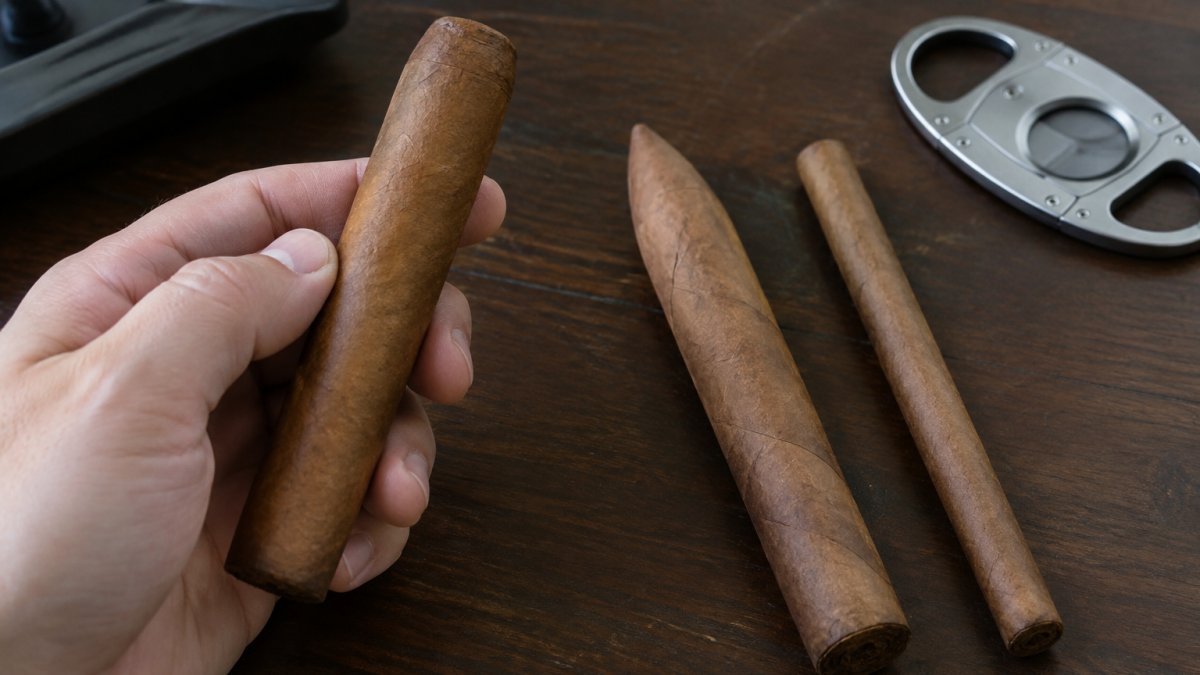
How We Test Draw Comfort
Before lighting, clip the cap and take three cold draws. A cold draw is a gentle pull of air through the unlit cigar. Rate the resistance on a three-point scale: easy (air moves with almost no effort), moderate (noticeable but smooth resistance), and tight (you have to work for it). Then light the cigar and repeat the check in the first third, the middle, and the final third.
This method matters because draw is not fixed at the factory. The same shape can smoke differently depending on how the filler is bunched, how the head is finished, and how the cigar has been stored. Testing before and during the smoke separates the shape's natural tendency from a one-off construction problem.
1. Robusto and Toro: The Most Forgiving Straight-Sided Shapes
The robusto is a parejo, usually around 5 inches long with a ring gauge in the high 40s to low 50s. Its wider body gives smoke room to move, which makes it one of the most forgiving shapes for a steady draw. The toro is a slightly longer, similar-gauge cousin and behaves much the same way. In cold-draw testing, both shapes tend to land in the easy-to-moderate range more often than thinner parejos.
The Padilla Italia Maduro box press Robusto 10 Pack is a practical place to start. Buying a 10-pack gives you enough of one shape to learn how it draws over several smokes. It is priced at $49.99. If you want to sample without committing to ten, the Padilla Salomon 5 pack - 7x57 offers a larger format for $39.99 and shows how a longer parejo draws.

Watch out: A box-pressed robusto can draw tighter than a round one if the press compresses the filler unevenly. Check the cold draw before lighting; if it feels tight, a second cut may free it up.
2. Corona and Lancero: Focused Airflow, Firmer Pull
Coronas and lanceros are thinner and longer, which concentrates airflow through a narrower channel. The lancero has a slender ring gauge, which produces a tighter draw.
If you want to try this shape, the Lancero, 5 Pack for Just $39.99 is available as a five-cigar option. Expect a firmer pull than a robusto.

Watch out: Lanceros have a long, narrow filler column, so a small packing inconsistency near the head can feel like a plugged draw.
3. Torpedo and Belicoso: Tapered Heads, Cut-Dependent Airflow
Torpedos and belicosos taper toward the cap, which narrows the smoke path at the head and widens it at the foot.
The Catcher in the Rye Torpedo 5-Pack at $29.95 offers five torpedo-shaped cigars to try. Because the cap is narrow, a sharp, shallow cut is the safest approach.
Watch out: Cutting a torpedo too deep removes the tapered shoulder and can open the draw so much that the smoke turns hot and loose.
4. Perfecto and Other Irregular Shapes: Character Over Consistency
Perfectos and other figurados with closed or tapered feet are the least predictable shapes for draw comfort. The changing diameter means airflow shifts as the burn moves through the narrow and wide sections. Some smokers love the evolving experience; others find the draw uneven. If even, comfortable draw is your priority, treat perfectos as a shape to explore after you have a baseline with parejos.
Shape-Specific Cutting Guidance
The cut is where shape and draw meet. Straight-capped parejos such as robustos, toros, and coronas take a straight cut across the cap; remove about 1/16 to 1/8 inch, or roughly two-thirds of the cap, and no more. A clean cut preserves the cap, while the cigar’s construction also shapes airflow, so laffogatocoffee.com fits naturally into the same consideration of what makes a comfortable draw.
Quick Ranking by Draw Comfort
Ranked from most to least forgiving for an even, comfortable draw: robusto and toro first, corona and lancero second, torpedo and belicoso third (cut-dependent), and perfecto last. Use the cold-draw test on your first cigar of any new shape, and let the result guide your next purchase rather than the label alone.
The table below compares the shapes covered in this ranking, so you can see at a glance how each one tends to draw.
| Shape | Draw tendency | Watch out for |
|---|---|---|
| Robusto and toro | Most forgiving, easy to moderate | Box press can draw tighter |
| Corona and lancero | Focused airflow, moderate to tight | Packing inconsistency near head |
| Torpedo and belicoso | Cut-dependent, narrow head | Cutting too deep loosens draw |
| Perfecto and irregular | Least predictable | Airflow shifts through the body |
Cigar Ring Gauge and Draw: How Thickness Changes Resistance
Ring gauge is the diameter of the cigar measured in 64ths of an inch. A 50-ring cigar is 50/64 of an inch across.
Thinner cigars, such as lanceros, offer a tighter draw and a more concentrated flavor. Neither is inherently superior. If you are new to a shape, start with a mid-range ring gauge and adjust from there.
Best Cigar Shapes for Beginners and Comfort Across Hand Sizes
Beginners usually do best with a robusto or toro. The wider ring gauge is forgiving if the cut is not perfect, and the shape is easy to hold.
Comfort also depends on the situation. A long, slow smoke on a porch suits a larger format, while a shorter cigar fits a quick break. Choose a shape that matches how much time you have and how you hold a cigar.
How to Fix a Tight Cigar Draw Before You Light Up
A tight draw is rarely caused by shape alone. Construction, humidity, and storage all change how air moves through the same shape, so the fix depends on the cause. Work through these checks in order before you light up.
Step 1: Test the Cold Draw
Clip the cap and pull gently on the unlit cigar. Air should move with little effort. If it feels restricted, the problem is either the cut or the packing, and you can often tell which by where the resistance sits. Resistance right at the head points to the cut; resistance deeper in the body points to the filler.
Step 2: Adjust the Cut
If the cold draw is tight at the head, remove a little more of the cap with a sharp cutter, taking care not to cut past the shoulder.
Watch out: Cutting too deep is a one-way fix. Once you remove the shoulder, the wrapper can unravel and the draw can open beyond what you wanted. Cut in small increments and test after each one.
Step 3: Check Humidity and Storage
Cigars stored too wet draw tight because the tobacco swells and closes the air channels. Cigars stored too dry can also draw poorly, because the filler shrinks unevenly and creates blocked pockets. Cigars generally benefit from storage in a humidor held at a stable humidity and from resting after shipping. If a cigar feels tight and spongy, it is likely over-humidified; give it time in a stable humidor before smoking.
Step 4: Consider Construction
Even a well-stored cigar can draw tight if the filler was bunched too densely or if a stem or plug sits in the air path. This is a manufacturing inconsistency, not a shape flaw, and it can happen in any format. To check whether a cigar is stale or poorly built before you reach for one, read this inspection guide for the signs to look for.
Step 5: Change the Shape While You Learn
If tight draws keep happening across different cigars, the shape may be working against you. A wider ring gauge such as a robusto or toro carries more air across a wider cross-section and is generally more forgiving than a slender lancero or a narrow tapered head. Trying a different shape with a wider ring gauge can help while you learn your preference, and it separates a personal mismatch from a bad cigar.
When to Stop Troubleshooting
If a cigar stays tight after a proper cut, a rest at stable humidity, and a gentle draw-tool pass, set it aside. Forcing a plugged cigar usually leads to hot, harsh smoke and a canoeing burn. The useful takeaway is to note the shape, the storage conditions, and where the resistance sat, so your next purchase is informed by evidence rather than guesswork.
Pick Your First Padilla Shape and Start Smoking
If you are choosing your first shape, start with a robusto or toro for the most forgiving draw, then try a corona or torpedo to compare. The Padilla Italia Maduro box press Robusto 10 Pack is one option for a first purchase, since a robusto is a forgiving shape to learn on. Padilla offers free shipping on U.S. orders over $100.
Frequently Asked Questions
What cigar shape is best for an even, comfortable draw?
Robustos and toros usually give the most forgiving draw for most smokers. Their straight sides and larger ring gauge spread the tobacco more evenly, which reduces the chance of a tight spot. Padilla's Meaty Maduro 6x60 and Italia 4.25 x 60 Gordito are both large-gauge options. Torpedoes and lanceros can draw well too, but they depend more on the roll quality and a clean cut.
Are robusto cigars easier to draw than torpedo cigars?
In most cases, yes. A robusto has a wider ring gauge and a blunt head, so it moves more air through a larger tobacco column. A torpedo's tapered head concentrates the draw at a smaller opening, which can feel tighter for some smokers. A well-made torpedo still draws comfortably, so cutting and construction matter as much as shape.
Does ring gauge affect a cigar's draw?
Yes. Ring gauge is the cigar's diameter in 64ths of an inch, and a thicker cigar holds more tobacco and more air space. Thicker cigars typically draw more openly, while thinner ones like the 38-ring Lancero can feel more restricted. Padilla's Lancero 5-pack and The Catcher in the Rye Torpedo, at 52 ring gauge, illustrate how gauge shapes the smoking experience.
How can you tell if a cigar has a good draw before lighting it?
Gently roll the cigar between your fingers to check for soft spots, then draw air through it without lighting. You should feel steady resistance with no sharp pinch. Check the cap for a clean, even cut and make sure the wrapper is not cracked. If it feels rock-hard or hollow in spots, the construction may cause an uneven draw.
